Showing posts with label hot. Show all posts

Sunday, April 13, 2014

Tortilla Soup: Great Sick Food or Greatest Sick Food?

In 2000, Dr. Stephen Rennard of the University of Nebraska set out to design a study to examine if and how chicken soup might actually help people suffering from the common cold. In the study he started with his wife's recipe, handed down from her Lithuanian grandmother. Results from Rennard's study suggested that chicken soup may actually help fight colds by inhibiting the movement of a particular type of white blood cell that defends against infection. Rennard's team (and other scientists who have replicated the study since then) found similar results with other chicken soup recipes as well, though they couldn't identify which ingredients were key to the soup's immuno-supportive qualities. You can see Dr. Rennard's article, Grandma's recipe and some adorable pictures of him and his wife cooking soup together at the University of Nebraska Med. Center website.

When I ended up with a cold a couple weeks ago, I had very little energy, a fridge full of forlorn, half-eaten rotisserie chickens, and a craving for spicy food. There are always a few roast chickens languishing in the fridge; most weeks, Tom takes full advantage of the Friday two for $10 deal on them at the local supermarket, eats the breast (at least most of it) and then leaves them in the fridge. I'm not too big into plain roast chicken, but I hate letting something like that go to waste (my generalized guilt about wasting food is multiplied when an animal died to become that food), so I am constantly trying to find ways to sneak this leftover chicken into things. In this case, spicy chicken soup provided the answer to all of these queries.

I used tortilla soup, a chile-spiked, chicken-based soup with origins across Mexico, as a jumping off point. I spent a while curled under a blanket with a box of tissues and the laptop reading many recipes for inspiration. This recipe might take a little while, but it's one where there's not a whole lot of active time, which means there's time to stop and take a nap between steps. You may not have all of the ingredients that I did (nor the plague of half-eaten chickens) so for many of the ingredients here, I provide a few alternatives.

In the end, what I came up with was good enough to eat for several more days without getting bored and to make again even when I wasn't sick.

Chile Chicken Soup

gluten-free, dairy-free, optionally grain-free

    Ingredients:

  • 2 half-eaten rotisserie chickens (You can use 1-2 lbs of fresh/frozen chicken and simmer in 2-3 qts of chicken stock instead of water)
  • water to cover (3-4 qts)
  • 2 tsp. light-flavored oil
  • 2 small-medium onions
  • 8 cloves garlic
  • 6 Dried Anaheim chiles, toasted* (or about ¼c. paprika, see note about chiles)
  • 2 chipotle chile (or 1-2 tsp. chipotle powder, scaled to taste, or ½-1 tsp. cayenne)
  • 2 tsp. ground cumin
  • 2-3 bell peppers, fire-roasted (I used a combo of red bell and cubanelle)
  • 1/2 can crushed tomatoes
  • salt to taste
  • handful cilantro
  • 2 T masa harina made into a slurry with about 1/4 cup water, stirred in close to the end (optional, adds body)
*About Chiles I used California Anaheim and chipotle peppers. California Anaheims are milder than the already fairly mild New Mexico Anaheims. I buy them in a big bag as "California Chiles" at my local international market. They add a lot of rich chile flavor with virtually no heat. That's (part of) what the chipotles are there for. Chipotles are smoke-dried jalapeño peppers and add both heat and a rich, smoky flavor. I'd actually prefer to use a blend of these with dried pasilla chiles (also called chile negro), which are somewhat spicy and have a slightly darker flavor, but I didn't have any on hand. Anchos (dried poblanos) would also be good here. Additionally, you can replace these with about ¼ cup sweet paprika and about ½ tsp. of cayenne.

    Topping suggestions:

  • tortilla chips (if you want to be fancy, fry your own tortilla strips)
  • avocado
  • lime
  • more cilantro
  • sour cream
  • shredded jack, cheddar or queso blanco cheese
  • chili sauce

Before we get started, let me introduce you to my spice grinder. This is one of my best friends in the kitchen. It's not that I'm a fresh-ground spice purist (I'm not), it just allows for so many more options: getting to make chili powder out of whichever dried peppers I like, pulverizing the dried shiitake mushrooms I like sneaking in all over the place, not having to buy both whole and ground versions of spices I use in both forms. Yes, it does say über super coffee grinder on the side. You can buy devices labeled "spice grinders" but many comparisons I've seen say you're better off with a small, blade-driver electric coffee grinder unless you are regularly grinding very large quantities. Additionally, little coffee grinders are cheap. You can reliably buy them new for under $20, commonly find them at thrift stores or tag sales for <$5, and sometimes find them for free at the dump swap shop, if you are lucky enough to have such a thing, or from someone who is moving, giving up coffee, or getting rid of it for some other reason. I used to have two, one for coffee and one for spices, but the one which had served as spice grinder for nearly a decade gave up the ghost this winter, so the coffee grinder got promoted.

On to soup, though. If you're using leftover roasted chicken(s), break apart chicken carcasses just enough so they fit in stockpot well. Leave any remaining meat intact. Add any languishing veggies (got half an onion? some sad, floppy carrots? half a shriveled beet? throw them in!). Add water to cover, simmer for 1 hour, let sit for 1 hour, then pick the meat off of the bones (it will fall off). I find that with 4 quarts of water, I end up with about 2½ quarts of stock with the evaporation that happens. Sometimes I cook the stock down a little further. If you are using fresh meat, pour about 2 qts of stock over 1-2 lbs chicken and simmer for about an hour and sit for about an hour. Either way, strain the chicken over a bowl shred the meat with your fingers or with two forks if it's too hot to handle. Add the chicken to the reserved stock or the other way around, whichever fits better, to use the stockpot to get the next part ready.

Next, roast the sweet peppers. If you have a gas range, you can put the peppers right on the burner grate over a medium flame and turn every minute or so until the outside is blistered, peeling a little, and has some lovely blackening on the skin all around. Then, place them in a covered dish so they can finish steaming from within. If you have an electric range, you can check out some of the suggestions offered here. You can also elect to simply chop up your peppers and cook them with the onions and garlic, but roasting them brings out their sweetness and adds the depth that only light charring can bring.

Dice the onions, slice the garlic, cook in light-flavored oil in stock pot over med-low heat, stirring frequently until well-browned and tasty smelling. Add non-chile spices to onion/garlic and stir until fragrant. Take a handful of cilantro, cut (but keep!) the stems. Finely chop the stems and roughly chop the leaves, then add to the onions, garlic and spices, then return chicken + broth to pot.

If using whole chiles, toast them over the stove as well. Either grab them with tongs one at a time and wave them over the flame until they get fragrant and a little puffed or toss them in a dry cast-iron skillet over medium-low heat until a similar effect is achieved. Tear them up, remove the stems and grind. I can only fit one or two in my grinder at a time, so it takes a few batches. I just dump them right into the pot as they come out.

Take stems & seeds out of the sweet peppers, if you didn't add them with the onions and garlic. Either chop them finely or run them through food processor. Add chopped peppers and crushed tomato to soup. A nice, but not essential touch here is to take a few tablespoons of masa harina (the specially-treated corn flour used for making tortillas), mix with some water and add the the soup. It gives the soup a hearty, satiny body, but it's not worth buying masa harina just for this. The soup will be plenty tasty without.

Adjust the seasoning. I usually serve with some assortment of tortilla chips, fresh cilantro, avocado cubes (don't skip these!) and lime wedges. Other people reportedly like adding sour cream or shredded mild cheese. Regardless, let diners add their own flair. As much as the tortilla bits give the soup its name, it's pretty good without them, too, if you don't have them or aren't eating corn for whatever reason. I also like to put out some chili sauce, so that diners can adjust the spiciness to their liking.

Thursday, May 9, 2013

Curried Tempeh with Mustard Greens and Cellophane Noodles

I'll be perfectly honest: I didn't like tempeh as a kid.

In fact, early experiences with tempeh meant that I didn't give it much of a chance again until about a year ago, but, boy howdy, am I making up for lost time.

Tempeh is a protein-rich food made from split soybeans and, sometimes, a variety of grains which have been parcooked and innoculated with Rhizopus oligosporus, a type of fungus, and incubated for 24-48 hours. The culture partially ferments the legumes/grains, making them easier to digest, and binds them together into a firm cake with a mild flavor somewhere between nuts and mushrooms. It can be sliced or crumbled and holds up to grilling or stir-frying. Most tempeh is gluten-free, but, if you're concerned about that kind of thing, it's important to read the labels on multigrain tempehs, which vary in contents, but sometimes include gluten-bearing barley or rye.
In its native Indonesia, it's very often served fried or grilled, often with some kind of lightly sweet & spicy accompaniment. Peanuts turn up with it a lot too. For me, I've found that I still don't fancy the taste of plain tempeh - despite liking nuts, mushrooms and tempeh - but that sauteéing it until it's a little crispy with some salt or soy sauce makes a world of difference.

Recently, I've been cooking it up in a spicy-sweet stir-fry with mustard greens, largely inspired by this South Indian take on tempeh from Delectible Victuals, with the addition of a generous helping of fresh cilantro, including the stems. It's good over rice, but it's great tossed with thin cellophane noodles, made from mung beans and also gluten free (available at Asian markets - rice vermicelli is a good, slightly more common replacement and any other thin, clear noodle would work). If you want to serve with rice or bread, you can simply omit the steps in the recipe below involving the noodles. It's also at least as good cold the next day.

Curried Tempeh with Mustard Greens and Cellophane Noodles

vegan, gluten-free (depending on tempeh, soy-sauce)
Ready in about 30 minutes, serves 2-3
  • 1 small-medium onion, small dice
  • 2-3 cloves garlic, minced
  • ½ red bell pepper, medium dice
  • 1-2 tsp. light-flavored oil
  • 1 tsp. ground turmeric
  • handful cilantro
  • soy sauce
  • 1 Tblsp. sugar
  • 1 8-oz. package tempeh, crumbled
  • thick chili sauce, like sambal oelek or sriracha, to taste (start with 1-2 tsp.)
  • 1 good sized bunch mustard greens or other medium-weight green like swiss chard, sliced into 1" ribbons
  • about 4 oz. dried cellophane noodles - in the packages I get, this is two bundles
  • crushed peanuts (optional)
Start by putting the noodles in a bowl of warm water to soak, which is all the precooking they need. They will need to soak at least 15 minutes. Prep the veggies and crumble tempeh coarsely. Cut off the bottom half of the cilantro stalks. Set aside the leafy end for later and mince the stem end very small.

Heat a large wok or skillet over a high heat. Add a teaspoon or two of oil and swirl to coat. Add tempeh and a teaspoon or two of soy sauce. Cook until tempeh becomes browned and a little crispy. Set aside and try not to pick at it too much. Wilt the greens slightly in a separate pan with a tight fitting lid by putting on medium-low heat with a tiny bit of water in the bottom. The greens will reduce in volume by at least half.

Add a little more oil to the wok or skillet and add the onions, garlic, bell pepper and minced cilantro stem. Saute until the peppers and onions get a little color, then add the turmeric and sugar. Add the tempeh and chili sauce. Drain the noodles, then add the wilted greens and noodles to the wok or skillet. Toss to combine. Remove from heat and toss with roughly chopped cilantro leaves. Adjust soy sauce, chili and sweet levels as desired. Serve with optional crushed peanuts on top.

Friday, December 21, 2012

Snappier Ginger Snaps

All my favorite winter weather dishes come from hot climates: Spicy coconut curry, robust moles. I understand the theory of spicy foods for hot climates: that it causes you to sweat which, in turn, helps you cool down. It just happens to make just as much sense in a situation where it can't heat you quite to the point of sweating. Maybe, to the point of taking off a sweater.

Why should savory foods have all the fun, though? Even sweet foods that should be spicy aren't. Consider gingerbread: if you eat fresh ginger, candied ginger, or the right kinds of ginger beer, it will, at the very least, tingle your tongue a bit. However, your average gingerbread cookie doesn't have anywhere near the bite of fresh ginger. When it comes down to it, you're simply not going to get that flavor from ground, dried ginger. So, I decided to call in reinforcements. My mom, in her baking days, let me in on her trick of using black pepper in her her gingerbread. I decided to raise the stakes to red pepper. I brought the first batch into work, and I had some folks declaring them the best gingerbread cookies they'd ever had and some running for the water fountain (I dialed down the chili powder the next time I made it).

This recipe is a variation on the the crinkle cookie - a sticky dough rolled in sugar, the sugary crust crackling as the cookie rises and spread. There are many schools of thought on thought on this type of cookie. Some recipes are built around whipped egg whites and a suspicious number start with boxed cake mix (?). Even more basic enough is the question of butter or vegetable oil. Many of the butter-based recipes (including an intriguing brown butter crinkle cookie) use it melted, so it comes down to a matter of flavor vs. convenience. You can make either of these recipes with butter instead, but increase to ¾ c. (1½ sticks).

Crinkle cookies are a great go-to when you have a burning need to make cookies - as happens - but are out of butter or don't have time to let butter soften (or if you're serving someone who can't have dairy).

Actually Spicy Ginger Crinkle Cookies

adapted from Megan Applegate's Nana's Recipe (which wasn't quite so spicy)
  • ⅔ cup vegetable oil
  • ¼ c. molasses
  • 1 egg
  • 1 cup sugar (+ 2-4 tablespoons for rolling)
  • 2 teaspoon gr. cinnamon
  • 2 teaspoon gr ginger
  • ½ tsp gr. clove
  • ¼-½ tsp. gr. chili (I used chipotle)
  • ½ teaspoon salt
  • 2 teaspoons baking soda
  • 2 cups all-purpose flour

Preheat oven to 350°
Whip oil, molasses, sugar, egg to creamy. It will still have a loose texture, but will emulsify some. Add spices and beat on low to incorporate. Add baking soda, salt, flour and mix on low to blend.

If you're patient, you can stick the dough in the fridge for an hour and it will stick to your fingers a little less. If you don't mind a little cookie dough on your hands, barrel right along. Roll into walnut-sized balls (~1" diameter), roll in granulated sugar, place on a parchment-lined sheet pan and bake at 350° for 10-13 minutes. They will seems very soft when they come out, but resist the urge to put them back in. If you bake them until they feel firm, they will be too hard and dry when they cool off. Feel free to experiment with what time/size combo works best for you, but this arrangement gets me lusciously chewy cookies.

Wednesday, November 7, 2012

Butternut, Coconut, Curry-nut?

Apparently, this has turned into the squash blog. Realizing this would be my third subsequent squash post, I almost posted about something else. However, the following things occurred to me:
  1. These are three quite different squash recipes, illustrating the versatility of the vegetable.
  2. Who would come here who doesn't want to hear more about squash‽
In my last post about squash-filled profiterole, I went on, possibly at too great a length, about why roasting a bunch of squash and keeping it in your fridge is a fabulous idea. I won't repeat myself, but it is; consider this recipe Exhibit B in the case. A rich, satisfying dish that balances sweet and savory, this contains a complete protein when you add rice and happens to be vegan, gluten-free and nut-free (the coconut, despite its name, does not affect those with tree-nut allergies).

As long as you already have roasted squash, this curry comes together in no time flat - about 20 minutes at the outside. Although I sometimes recommend forgetting to start the rice until well into cooking a dish to give you an incentive to let something simmer longer, this is a dish where you want to make sure to start the rice ahead of the other dish so you won't end up waiting on the rice.

I used a smallish (probably 2-3 lb) butternut squash for this dish, but other varieties of winter squash will also work. To roast squash, halve it, scoop out the seeds and place on a lightly oiled (foiled if you don't want to scrub) baking sheet. Bake at 375° for 35-60 minutes. Check at 30 minutes and poke the squash at its thickest part, then estimate how much longer until it's tender or check every 5-10 minutes.

Squash, Coconut & Chickpea Curry

vegan, gluten-free, nut-free
Takes about 20 minutes, serves 3-4
  • about 2 lb winter squash, roasted and cut into 1" cubes
  • 1 onion
  • 3 cloves garlic
  • 1 tsp brown mustard seed
  • ½ tsp. fenugreek seed
  • 1 tsp. cumin seed
  • ½ tsp. turmeric
  • ½ tsp. coriander
  • ½-1 tsp. red pepper flakes
  • ½-1 tsp. salt
  • 1 15 oz. can chick peas, drained
  • 1 can coconut milk
In large, heavy bottomed pot, heat a few teaspoons of veg. oil over high heat. Add mustard, fenugreek, cumin and coriander. Once the seeds start to sizzle and pop, add the garlic and onion. Once onion has started to soften and brown a bit, add chick peas, turmeric, red pepper and salt. Toss, then add squash and coconut milk. The squash will start to break down and blend into the coconut milk, making for thick, saucy goodness. The squash shouldn't totally dissolve and dissappear, though.

Simmer for a few minutes, adjust seasoning and serve over rice. Cilantro is also nice addition right at the end, too.

Tuesday, October 16, 2012

Garlic & Proust: How to Find Out Who Your Real Friends Are

It is plain that the truth I am seeking lies not in the cup but in myself.
—Marcel Proust, In Search of Lost Time

Don't underestimate the importance of messy, imprecise and sometimes smelly personal rituals like garlic spaghetti. It's difficult to get out of the mindset of ritual being the province of traditional religion; after all, it does share a root with the word rite. But if you take it back even farther, it also shares a root with rhythm, which makes at least as much sense: ritual has as much to do with the beat, the repetitive, familiarly measured flow of action.
It's a way of connecting with personal history, enlivening more abstract, nebulous memories with the more immediate, classical five senses. If nothing else, it's vastly more productive and less creepy means of reminiscing than many others. Proust famously wrote about this phenomenon in In Search of Lost Time, describing and then attempting to deconstruct an inexplicable bliss that came out of eating a bite of madeleine soaked in lime-blossom tea, finally attaching it to time spent with his aunt as a child.

Imprecise memories don't necessarily require precise remembrance. I first learned about garlic spaghetti from a college friend. Our relationship was largely based around cooking together: we lived in the same vegan co-op, worked at the same (non-vegan) restaurant off campus, and found (sometimes invented) plenty of reasons to be hungry and cook together outside of that. To be quite honest, most of my memories of this friendship are messy and smelly, but they're also distinctly delicious.

Garlic spaghetti was a family favorite of his: thick pasta coated in a buttery Parmesan sauce loaded with raw garlic. It may be vegetarian, but health food, this ain't. It started out innocently enough. We'd peel up 4-5 cloves of garlic for a pound of pasta. It was garlicky, but still fairly accessible. However, we had some sort of ongoing need to out-badass the other, and so every time we made it, the garlic content went up. We made this about once a week. By the time I got to making it for my family back home during Winter Break, it had gotten to a point where we were using at least a full bulb of garlic for the two of us. My family thought I had totally lost it and were ruined on the dish, despite being people who like garlic fairly well.

I made it for the first time in several years the other day. My sister and I had, coincidentally, both been thinking about it. I made the sauce with 5 cloves of garlic for the two of us, staying on the conservative side, but wondering how my own tolerance had slipped from the full-bulb dragon-breath days. I thought it could have used a little more garlic.

If you aren't willing to use at least a clove of garlic per person, don't bother. Remember, though, that garlic breath is only a problem for those who don't have it. The friend from whom I learned this dish insisted it was best served with fake bacon bits, and further insisted that they were preferable to real bacon in this case. I don't know that it holds for me, but Bac-Os (or their generic Head Nut-bought equivalent) were an essential piece of the garlic spaghetti ritual in college, and I would be remiss not to mention them. Here, I've tossed some fresh arugula with the hot pasta, letting it wilt gently into the dish, which is an entirely different but, but still nice, touch.

And fear not the leftover garlic spaghetti! For there do you stumble upon another piece of the ritual: the leftover garlic spaghetti omelette. It pretty much explains itself.


Garlic Spaghetti

vegetarian, optionally gluten-free
serves 3-4, takes 30-40 minutes start to finish
  • 1 lb spaghetti (this is the only ingredient with gluten: gluten-free pasta = gluten-free dish)

  • Sauce

  • 4-5 cloves garlic
  • 2 Tblsp. butter, room temperature
  • 1 egg (if you double the recipe, still use 1 egg; 3 or more times the recipe, increase egg)
  • ½ c. good grated Parmesan
  • 1-2 Tsp olive oil

  • Optional accoutrements:
  • fresh ground black pepper (I lied, this is obligatory)
  • fresh arugula or spinach
  • bacon bits, fake or otherwise
  • red pepper flakes, if it isn't hot enough for you already (in the badass times, this was a common addition)

Start by putting the pasta water on to boil. Peel the garlic cloves, grate cheese if necessary. Add ingredients to food processor or blender in the order listed, drizzling in the olive oil last, in a thin stream. The sauce will have a thick, fluffy, almost mayonnaise-like consistency. It is also excellent as a spread on bread, and pairs really well with broccoli.

When pasta is cooked, strain and toss with sauce and fresh greens, if using, until pasta is well-coated and greens are slightly wilted. Serve with black pepper, bac-os, or whatever else appeals to you.

Monday, October 8, 2012

Quick Hits: Chile-Lime Winter Squash/Sweet Potato

It's that time of year where I fall in love with my favorite orange vegetables again - winter squash and sweet potato. Last year, my CSA farm's winter squash crop was drowned by Hurricane Irene. This picture to the right was taken in the squash field. From a kayak. The squash are under about 12 feet of Connecticut River.
They did find their princess in another castle, though, taking in their best sweet potato crop ever from a field a little farther away from the river. In many recipes, this one included, the two are interchangeable. They have very similar nutritional profiles, as well. They're both extremely high in Vitamin A (as are most orange vegetables) and very good sources of Vitamins C, B6, potassium and fiber.

This simple but striking presentation, dressed in sweet, tart and spicy, works equally well for either. Butternut squash is an excellent choice for a dish like this; it's fleshy and its thin skin means it doesn't need to be peeled, just well washed, before being cubed and roasted. Delicata's another good sweet, thin-skinned variety but have a lower flesh-to-seed ratio than butternut. You can eat the rind of any squash, but with many of the thicker-skinned squashes, like buttercup/kabocha, pumpkin or hubbard, you don't want to.

Chile-Lime Squash/Sweet Potato

vegan, gluten/grain-free
done in about 30 minutes, serves 4 as a side
  • 1 large butternut squash, cut to bite-sized wedges
  • or
  • 2 medium sweet potatoes, cut into bite-sized pieces
  • 2-3 Tblsp. olive oil
  • ½ tsp salt
  • 1 tsp cumin
  • 1 tsp cinnamon

  • Dressing:

  • 1-2 T honey
  • zest & juice of one lime
  • ¼-½ tsp. ground chipotle pepper
  • or
  • 1-2 canned chipotles, minced
  • or
  • 1 small red chile, minced
  • some fresh cilantro (optional), roughly chopped

Toss squash with olive oil, spread on sheet pan and sprinkle with salt, cumin, cinnamon. Bake at 450°F for about 25 minutes, turning once. Remove from oven and toss with dressing and cilantro

Sunday, September 23, 2012

Mole Gringo, with only a dozen(ish) ingredients

Reading about traditional moles makes me feel like a total poser, but it also makes me hungry. My students are currently reading What the Moon Saw, a thinly veiled ethnography of a rural village in the southern Mexican state of Oaxaca, for another one of their classes. I snagged it to read one day last week in the name of integrated curriculum and devoured it more or less in one sitting, give or take snacks. Oh, YF books, you go down so smooth. It is also a fairly good coming-of-age story about a teenage girl from the burbs of DC meeting her Mexican grandparents for the first time, finding out her grandmother is a curandera (shamanistic healer), and falling for a local boy who sings revolutionary songs real pretty. Moles, though never mentioned by that name are, along with hot chocolate and corn tortillas, essential to the story. In one of her grandmother's stories, a friend recalls a situation in which she planned on killing herself, but decided to make chicken with chocolate-chile sauce as a final meal and decided life was worth it after all. Mole proved to be her reason to keep living.

The word mole comes from a Nahuatl word, molli, which simply means "sauce," though it lines up interestingly with the direct-from-Latin Spanish verb moler, "to grind," an essential process in making mole. Nahuatl, a group of
languages from across southern Mexico, is the source for a surprising number of English words: chocolate, avocado, guacamole, tamale, chili, coyote, and tomato are all of Nahuatl origin, filtered through Spanish. Seeing as the term of origin is as broad as it is, it's unsurprising that there are a wide variety of moles across southern Mexico. They vary in complexity and focus, but have a few things in common: all begin with a variety of chiles, and from there are built out of spices and ingredients that make it sweet, like dried fruit; sour, like tomato or tomatillo; and thick, like nuts, seeds and starch. Oaxaca, where the book takes place, is known in some circles as the "Land of Seven Moles" but it's much broader than that - think of the seven moles a little like the five classic French mother sauces. They're more like guidelines. The most complex of these moles have nearly 40 different ingredients and can take days to make, so it's easy to see where folks might be overwhelmed by the idea of making it on their own for anything short of something very special, and miss out on the joys still available from a simplified mole.

Saturday, August 25, 2012

Spicy Tomato Peach Jam: Convergent Evolution?

One of my favorite writers, magical realist godfather Jorge Luis Borges, has a short story, "Pierre Menard, Author of the Quixote" (in Spanish; in English), which describes the efforts of a writer to rewrite the classic Don Quixote. Menard wishes not simply to reinterpret the story in his own words, but to cause himself to produce Cervantes' exact text, even if only a few pages thereof. He rejects his initial approach, "[to] know Spanish well, recover the Catholic faith, fight against the Moors or the Turk, forget the history of Europe between the years 1602 and 1918, be Miguel de Cervantes," as too simple, and decides instead, "to go on being Pierre Menard and reach the Quixote through the experiences of Pierre Menard." For additional absurdity, the story is presented as an obituary of sorts for Menard, who never actually existed.

I was put in mind of this yesterday when I spontaneously recreated a recipe I had merely skimmed during initial research for a tomato jam I decided to make after coming home from the farm with an entire flat of tomatoes. Given, this is a much less onerous task than recreating Quixote; there's a reason you can't copyright a list of ingredients. And, in truth, a list of ingredients is not a recipe.

Saturday, August 13, 2011

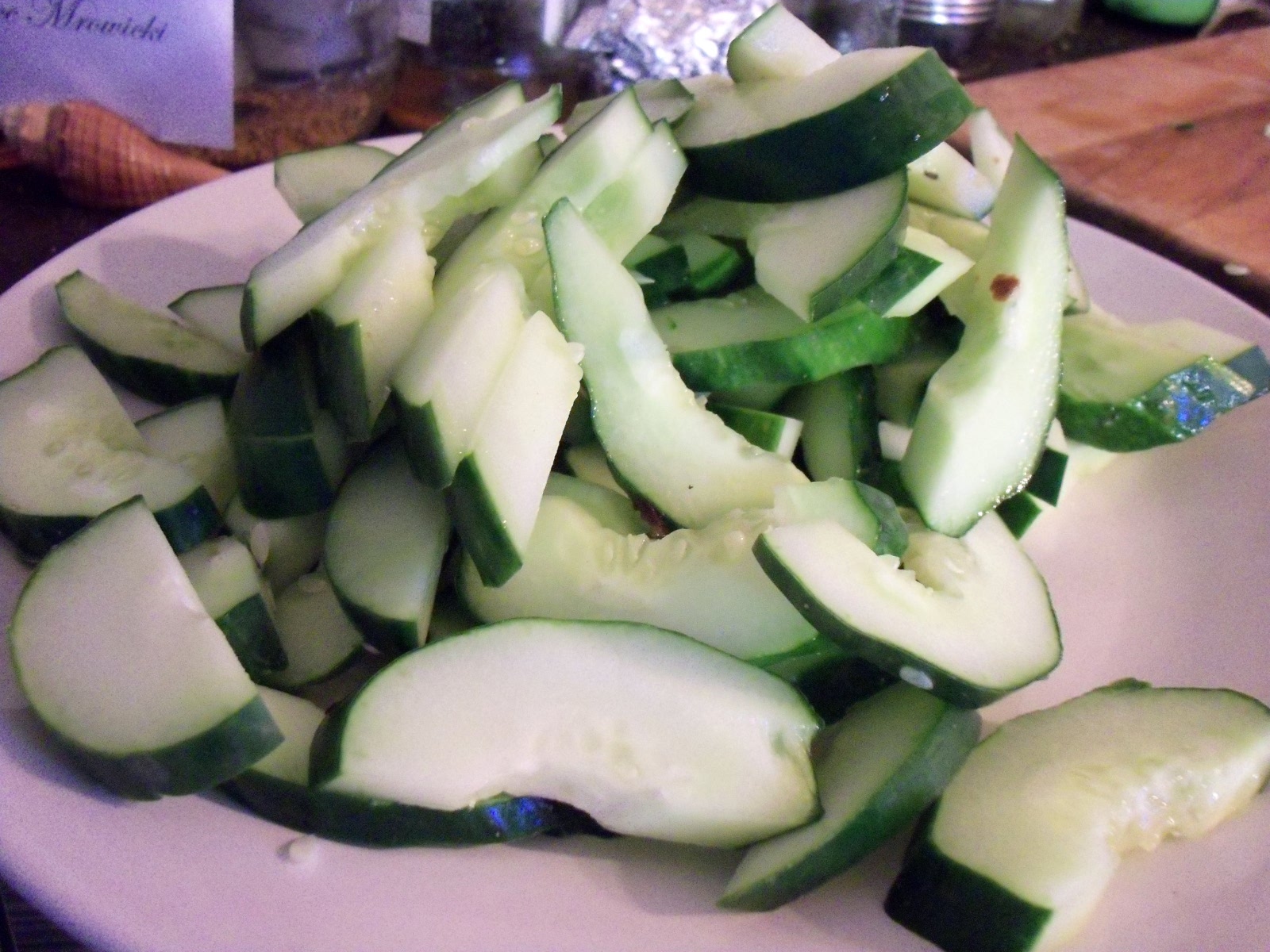
Shiitake Part 2: Hot Cucumber Salad

As the last post discussed, we returned from Tuesday farmer's market with a pint of fresh, local shiitake mushrooms and were determined to make them shine in simple dishes.

Two days later, a friend of ours showed up for dinner with a flat of fresh veg. from the farm where he's been living. He turns up occasionally with interesting selections of ingredients in search of a good home. Friends like this are good friends to have. This haul included a few pints of different tomato varieties, several colors of summer squash, a half-dozen cucumbers, some mismatched eggplants and a tiny, heart-sized watermelon. While compulsively munching little, orange, crack-laced tomatoes, we described a dish another recent dinner guest had shared with us that we found astonishing: hot cucumber salad. Something she had picked up in her travels in Western China, primarily Gansu province, the dish is hot in both senses of the word: served hot from the wok and liberally dosed with chili and garlic.

Up until then, it hadn't occurred to me to do a cooked dish composed primarily of cucumber; it seemed anathema to the vision of cucumber as cool, crisp crunch. Most of the hot cucumber I'd eaten involved throwing some into a fried rice in its very last moments on the stove, or including it al minuto in a brothy soup. This dish totally sold me on the idea, though. Remembering a languishing, slightly wilted half-head of greenleaf lettuce, we decided to add that, making it somewhat of a hot reimagining of a green salad. Also, it seemed a perfect foil to our plan for the second half of the fresh shiitakes, cooking them with Korean rice cake.

Korean rice cake (dduk) is a little like a giant, glutinous rice noodle (which, despite the name, is gluten-free), which we buy sliced on the bias into rounds. It has a thick, chewy texture and pairs well with all kinds of things. In fact, between that and gochujang, a thick, chili-based condiment that has been near indispensable in Korean cuisine since the introduction of chili in the 18th century, you have a kick-ass base for a stir fry which you can plug almost anything into. But that's a story for another day: gochujang would have overwhelmed the delicate little mushrooms.

Instead, we cooked the rice cake with a little bit of onion, oil and salt over high heat to get a little bit of toasty char flavor (contrary to what some may say, burnt is a flavor; you just probably don't want it to be the dominant flavor of your dish), took it out, cooked the mushroom similarly, and then tossed them together. And we saw that it was good. It's so simple, it's almost redundant to write a formal recipe to follow that.

    Hot Cucumber Salad

    vegan, gluten-free
    Serves 2-3
  • 2 med-large cucumbers, halved, seeded and bias-sliced med. thick
  • 3 cloves garlic, minced
  • 3 whole, dried red chilis, broken loosely
  • OR
  • 1 tsp. red pepper flake
  • 2 tsp. peanut or neutral oil
  • ½-1 tsp. salt

  • Optional:
  • 1 small head leafy lettuce, sliced into 1" strips
  • 1 Tblsp. rice vinegar
Prep vegetables. Heat wok over high heat. Swirl in oil. Add red pepper and about half the garlic. Tossing until the garlic smells toasty, about 10 seconds. Add cucumbers and toss. Sprinkle with about half the salt. and toss occasionally until cumbers start to get slightly soft, about 2-3 minutes. Add lettuce and vinegar, sprinkle with remaining salt and garlic. Toss to combine and cook until lettuce is somewhat wilted, 1-2 minutes.

    Shiitake & Rice Cake Stir Fry

    Vegan, gluten-free
    Serves 2, unless you've been sitting around eating too many little tomatoes, in which case it may serve 3
  • ~1 lb sliced rice cake (½ the bag)
  • ½ med. sweet white onion, med. dice
  • 4 tsp. peanut or neutral oil
  • 1 tsp salt
  • 1 c. fresh shiitake, sliced
  • ½ c. baby bella/crimini mushrooms, sliced
Heat wok over high heat. Swirl in 2 tsp. of the oil and add half the onion. Toss and add the rice cake. Sprinkle with half the salt. Toss/stir occasonally, letting the rice cake get a few charry speckles and the onion get a little soft, about 5 minutes. Remove to serving bowl.

Swirl in the other 2 tsp, of oil, add mushrooms and remaining onion. Sprinkle with remaining salt. Stir/toss until mushrooms & onions start getting soft, 3-5 minutes. Turn off heat, add rice cake back to wok and toss until combined.

LinkWithin

Related Posts Plugin for WordPress, Blogger...