Showing posts with label simple. Show all posts

Wednesday, November 7, 2012

Butternut, Coconut, Curry-nut?

Apparently, this has turned into the squash blog. Realizing this would be my third subsequent squash post, I almost posted about something else. However, the following things occurred to me:
  1. These are three quite different squash recipes, illustrating the versatility of the vegetable.
  2. Who would come here who doesn't want to hear more about squash‽
In my last post about squash-filled profiterole, I went on, possibly at too great a length, about why roasting a bunch of squash and keeping it in your fridge is a fabulous idea. I won't repeat myself, but it is; consider this recipe Exhibit B in the case. A rich, satisfying dish that balances sweet and savory, this contains a complete protein when you add rice and happens to be vegan, gluten-free and nut-free (the coconut, despite its name, does not affect those with tree-nut allergies).

As long as you already have roasted squash, this curry comes together in no time flat - about 20 minutes at the outside. Although I sometimes recommend forgetting to start the rice until well into cooking a dish to give you an incentive to let something simmer longer, this is a dish where you want to make sure to start the rice ahead of the other dish so you won't end up waiting on the rice.

I used a smallish (probably 2-3 lb) butternut squash for this dish, but other varieties of winter squash will also work. To roast squash, halve it, scoop out the seeds and place on a lightly oiled (foiled if you don't want to scrub) baking sheet. Bake at 375° for 35-60 minutes. Check at 30 minutes and poke the squash at its thickest part, then estimate how much longer until it's tender or check every 5-10 minutes.

Squash, Coconut & Chickpea Curry

vegan, gluten-free, nut-free
Takes about 20 minutes, serves 3-4
  • about 2 lb winter squash, roasted and cut into 1" cubes
  • 1 onion
  • 3 cloves garlic
  • 1 tsp brown mustard seed
  • ½ tsp. fenugreek seed
  • 1 tsp. cumin seed
  • ½ tsp. turmeric
  • ½ tsp. coriander
  • ½-1 tsp. red pepper flakes
  • ½-1 tsp. salt
  • 1 15 oz. can chick peas, drained
  • 1 can coconut milk
In large, heavy bottomed pot, heat a few teaspoons of veg. oil over high heat. Add mustard, fenugreek, cumin and coriander. Once the seeds start to sizzle and pop, add the garlic and onion. Once onion has started to soften and brown a bit, add chick peas, turmeric, red pepper and salt. Toss, then add squash and coconut milk. The squash will start to break down and blend into the coconut milk, making for thick, saucy goodness. The squash shouldn't totally dissolve and dissappear, though.

Simmer for a few minutes, adjust seasoning and serve over rice. Cilantro is also nice addition right at the end, too.

Tuesday, October 16, 2012

Garlic & Proust: How to Find Out Who Your Real Friends Are

It is plain that the truth I am seeking lies not in the cup but in myself.
—Marcel Proust, In Search of Lost Time

Don't underestimate the importance of messy, imprecise and sometimes smelly personal rituals like garlic spaghetti. It's difficult to get out of the mindset of ritual being the province of traditional religion; after all, it does share a root with the word rite. But if you take it back even farther, it also shares a root with rhythm, which makes at least as much sense: ritual has as much to do with the beat, the repetitive, familiarly measured flow of action.
It's a way of connecting with personal history, enlivening more abstract, nebulous memories with the more immediate, classical five senses. If nothing else, it's vastly more productive and less creepy means of reminiscing than many others. Proust famously wrote about this phenomenon in In Search of Lost Time, describing and then attempting to deconstruct an inexplicable bliss that came out of eating a bite of madeleine soaked in lime-blossom tea, finally attaching it to time spent with his aunt as a child.

Imprecise memories don't necessarily require precise remembrance. I first learned about garlic spaghetti from a college friend. Our relationship was largely based around cooking together: we lived in the same vegan co-op, worked at the same (non-vegan) restaurant off campus, and found (sometimes invented) plenty of reasons to be hungry and cook together outside of that. To be quite honest, most of my memories of this friendship are messy and smelly, but they're also distinctly delicious.

Garlic spaghetti was a family favorite of his: thick pasta coated in a buttery Parmesan sauce loaded with raw garlic. It may be vegetarian, but health food, this ain't. It started out innocently enough. We'd peel up 4-5 cloves of garlic for a pound of pasta. It was garlicky, but still fairly accessible. However, we had some sort of ongoing need to out-badass the other, and so every time we made it, the garlic content went up. We made this about once a week. By the time I got to making it for my family back home during Winter Break, it had gotten to a point where we were using at least a full bulb of garlic for the two of us. My family thought I had totally lost it and were ruined on the dish, despite being people who like garlic fairly well.

I made it for the first time in several years the other day. My sister and I had, coincidentally, both been thinking about it. I made the sauce with 5 cloves of garlic for the two of us, staying on the conservative side, but wondering how my own tolerance had slipped from the full-bulb dragon-breath days. I thought it could have used a little more garlic.

If you aren't willing to use at least a clove of garlic per person, don't bother. Remember, though, that garlic breath is only a problem for those who don't have it. The friend from whom I learned this dish insisted it was best served with fake bacon bits, and further insisted that they were preferable to real bacon in this case. I don't know that it holds for me, but Bac-Os (or their generic Head Nut-bought equivalent) were an essential piece of the garlic spaghetti ritual in college, and I would be remiss not to mention them. Here, I've tossed some fresh arugula with the hot pasta, letting it wilt gently into the dish, which is an entirely different but, but still nice, touch.

And fear not the leftover garlic spaghetti! For there do you stumble upon another piece of the ritual: the leftover garlic spaghetti omelette. It pretty much explains itself.


Garlic Spaghetti

vegetarian, optionally gluten-free
serves 3-4, takes 30-40 minutes start to finish
  • 1 lb spaghetti (this is the only ingredient with gluten: gluten-free pasta = gluten-free dish)

  • Sauce

  • 4-5 cloves garlic
  • 2 Tblsp. butter, room temperature
  • 1 egg (if you double the recipe, still use 1 egg; 3 or more times the recipe, increase egg)
  • ½ c. good grated Parmesan
  • 1-2 Tsp olive oil

  • Optional accoutrements:
  • fresh ground black pepper (I lied, this is obligatory)
  • fresh arugula or spinach
  • bacon bits, fake or otherwise
  • red pepper flakes, if it isn't hot enough for you already (in the badass times, this was a common addition)

Start by putting the pasta water on to boil. Peel the garlic cloves, grate cheese if necessary. Add ingredients to food processor or blender in the order listed, drizzling in the olive oil last, in a thin stream. The sauce will have a thick, fluffy, almost mayonnaise-like consistency. It is also excellent as a spread on bread, and pairs really well with broccoli.

When pasta is cooked, strain and toss with sauce and fresh greens, if using, until pasta is well-coated and greens are slightly wilted. Serve with black pepper, bac-os, or whatever else appeals to you.

Monday, October 8, 2012

Quick Hits: Chile-Lime Winter Squash/Sweet Potato

It's that time of year where I fall in love with my favorite orange vegetables again - winter squash and sweet potato. Last year, my CSA farm's winter squash crop was drowned by Hurricane Irene. This picture to the right was taken in the squash field. From a kayak. The squash are under about 12 feet of Connecticut River.
They did find their princess in another castle, though, taking in their best sweet potato crop ever from a field a little farther away from the river. In many recipes, this one included, the two are interchangeable. They have very similar nutritional profiles, as well. They're both extremely high in Vitamin A (as are most orange vegetables) and very good sources of Vitamins C, B6, potassium and fiber.

This simple but striking presentation, dressed in sweet, tart and spicy, works equally well for either. Butternut squash is an excellent choice for a dish like this; it's fleshy and its thin skin means it doesn't need to be peeled, just well washed, before being cubed and roasted. Delicata's another good sweet, thin-skinned variety but have a lower flesh-to-seed ratio than butternut. You can eat the rind of any squash, but with many of the thicker-skinned squashes, like buttercup/kabocha, pumpkin or hubbard, you don't want to.

Chile-Lime Squash/Sweet Potato

vegan, gluten/grain-free
done in about 30 minutes, serves 4 as a side
  • 1 large butternut squash, cut to bite-sized wedges
  • or
  • 2 medium sweet potatoes, cut into bite-sized pieces
  • 2-3 Tblsp. olive oil
  • ½ tsp salt
  • 1 tsp cumin
  • 1 tsp cinnamon

  • Dressing:

  • 1-2 T honey
  • zest & juice of one lime
  • ¼-½ tsp. ground chipotle pepper
  • or
  • 1-2 canned chipotles, minced
  • or
  • 1 small red chile, minced
  • some fresh cilantro (optional), roughly chopped

Toss squash with olive oil, spread on sheet pan and sprinkle with salt, cumin, cinnamon. Bake at 450°F for about 25 minutes, turning once. Remove from oven and toss with dressing and cilantro

Sunday, September 9, 2012

Chocolate Magic Cookies (gluten & dairy-free)

One of my early jobs in education was as a paraprofessional in an intensive special needs program. A number of the students with autism were on the gluten- and dairy-free Autism Diet, which purportedly ameliorated some of the regressive behaviors associated with the Autism Spectrum. I had—and continue to have—reservations about the effectiveness of this approach, but I'm neither an autism specialist nor a nutritionist, so it's not really up to me, and I don't think it's going to exacerbate the issue. However, I had one co-worker who insisted on calling it
the "fun-free" diet in a way that I found aggravating. The "fun-free" description seemed to riff on the infuriating, pervasive illusion that if something is good for you, there's no way it will taste good and its equally problematic corollary that if food tastes good, then there's no way it's good for you.

Similarly, there's this illusion about teachers that they can either be nice or demanding, and that only one of these qualities is effective. I remember reading one article which contrasted "the kind of teacher who brings in brownies" with "the kind of teacher that demands results." Seriously, who comes up with this festering load of flapdoodle? I bet it's the same people that think tasty and healthy are mutually exclusive. This isn't to say that there aren't teachers who mistake being liked for being respected, and end up foregoing academic rigor for fear of not being liked, but let me tell you this: brownies—or any other kind of food—have nothing to do with it. On the other side of it, there are also teachers who mistake being disliked for being respected, and brownies have nothing to do with that either.

Any time you share food with someone, it's an acknowledgement of your shared humanity. Even if it's just passing around a tin of Altoids, as a couple teachers I've had were fond of doing, you are demonstrating a simple need and enjoyment that you have in common. Beyond demonstrating that you're not a robot who sleeps standing up in the broom closet, you are breaking down the perceived otherness that keeps students from becoming invested in a subject. Even in a fairly concrete, objective topic like math, a student's ability to invest themselves in a topic, to work hard and internalize it is linked to their sense of being seen as a person. So yes, I am one of those teachers who brings edible treats in for my students on occasion. I am also one of those teachers who demands a lot of hard work. I see no conflict between these.

This year, I have several students with dietary restrictions, so most of my go-to treats leave someone out. Enter these mouthwatering, crackly-topped, fudgy cookies, which happen, by my old co-worker's definition, to be totally "fun-free." No dairy, no gluten, no flour at all in fact. No need: the sugar, cocoa and egg whites around which they're built contain none of those things.

My sister's been making this one where she works, and scrawled down the recipe for me. As long as I leave the nuts out, this addresses all of the dietary restrictions I face at school, without any weird ingredient replacements. Even better, it is an incredibly simple recipe. A little Googling tracks this recipe back to one by François Payard in Gourmet's April 2002 issue, as digitized by Molly Wizenburg at Orangette, though I'm not sure where specifically my sister got hold of it. Wizenburg calls them "Featherweight Cookies"; a very similar recipe circulates as "Chocolate Puddle Cookies." I'm going with "Magic Cookies" because they are pretty damn magical. Besides, who needs "fun" when you have magic?

    Chocolate Magic Cookies

    gluten-free, dairy-free, nuts optional
    25 minutes, start to finish, makes about 32 three-inch cookies

    Dry Mix:

  • 3 cups (12 oz) confectioner's sugar
  • ¾ c. cocoa powder
  • ¼ tsp. salt
  • 2 c. mix-ins (toasted nuts, chocolate chips, cacao nibs, etc)

  • Wet mix

  • 4 large egg whites (~1/2 cup), preferably at room temperature
  • 1 tsp. vanilla
Preheat oven to 350°. Mix dry ingredients together until well blended. Separate eggs and add vanilla. Add egg and vanilla to dry mix and stir until well-blended. Scoop about a tablespoon at a time onto parchment-lined sheet pans with plenty of room to spread (which they will start to do immediately) and bake for 12-15 minutes, or until cookies are puffed up and cracked on top. It possibly goes without saying that to keep these gluten and dairy free, your mix-ins must also be, and that label reading is up to you (especially on chocolate chips!). You also may not care. I actually wonder how salted pretzel bits would work in here.

Monday, September 3, 2012

The Co-op's Korean Spinach

I'm pretty sure that the reason I would happily down this entire bowl of spinach has more to do with it being tasty than about it tasting like good memories, but it can be hard to tell the difference sometimes.

This is a great spinach dish for people who think they don't like spinach: it has a mild, savory flavor that enchants all kinds of palates. It's also, starting with frozen spinach and adding very little, highly nutritious and cheap as chaff.

Thursday, August 16, 2012

Russian Eggplant "Caviar"

I recently lost my main Russian grocery hookup when the last of my stepmother's family pulled up roots from their largely Russian Northeast Philly neighborhood. Our shared background in Russian Studies has been a major bonding point for us. I first met her shortly before I started studying Russian towards the end of high school and she was a big part of my reassuring my parents that it was perfectly fine to send me off to Central Asian parts of the former USSR back in 2002, based on her own experiences in the USSR in the late 70s/early 80s (my parents have never leaned towards being overprotectively alarmist, but anywhere ending in -stan raised a high eyebrow that close to 9/11 and the beginning of US involvement in Afghanistan). A couple times a year, she'd call to say, "Hey, I'm going to visit my mom for a few days. You want anything from Bell's?" (referring Bell's Market, the go-to Russian store in Philly). We'd go on for a few minutes about all the different kinds of frozen dumplings, smoked fish, cold salads and baked goods available there, which inevitably turned into reminiscences of particular meals and dishes from our travels. Every culture has its notable culinary adventures, but Russian culture in particular seems to keep the kitchen table at its heart. I'm reminded of a toast in honor of the kitchen table from Dennis Danvers's novel, The Watch:
"The Kitchen Table...is the site of all that's best in Man—his sociability, his intellect, his good humor, and his generosity—not a monument to death but a celebration of living, not the theft of life but its sharing, not the jingoistic cant that generally passes for history but here and now, together in solidarity, this very moment! I give you: The Kitchen Table!"
This toast is delivered by none less than Peter Kropotkin, or at least a fictional, time-traveling version of him, though I could imagine a similar proclamation coming from the man himself.

In any event, one of the Russian specialties that we always lingered over was баклажанная икра (bak⋅la⋅zhan'na⋅ya i⋅kra'), which literally translates as, "eggplant caviar." For all that it's called "caviar," baklazhannaya ikra is a totally vegan "salad" (Russian salads rarely involve leaves) made of eggplant, tomato, pepper, onion and carrot slow-cooked together to savory perfection and seasoned with the only two herbs that really matter in Russian cuisine, dill and parsley

Wednesday, August 15, 2012

Quick Hits: Lentil, Herb & Feta Stuffed Tomatoes

The months of drooling, rhapsodic fantasies about perfectly-ripened field tomatoes have finally given way to a flood of them. It's not an overabundance; that would imply too much. The simple joy of slicing a tomato, sprinkling it with salt and maybe drizzling a little olive oil over it hasn't gotten old yet, but there's so much more to do with tomatoes before you even get to cooking them. I tossed together this fresh-stuffed tomato using some left over odds and ends recently and was so excited about it that I had to recreate it and write it down to share.

The dish is built around a protein-rich lentil and grain stuffing, simply flavored with a healthy handful of fresh herbs, a little feta, and the guts of the scooped-out tomato. It may look like a salad, but it eats like a meal.

Monday, July 30, 2012

Raw-Pack Canning Blueberries in Juice

Yesterday marked the 6th annual Boston Skillshare, and the third that I have been involved with. The last two years, I facilitated workshops on reclaiming yarn, basic auto maintenance, and beginning ukulele. Apparently, I can't stop teaching, even on weekends and vacations. This year, I facilitated a workshop on canning and pickling, by request. I had originally wanted to walk through canning tomatoes, but we have not quite reached the deluge of tomatoes that will be here in a week or two, so I went with blueberries instead. Blueberries are a particularly easy food to can: they don't need to be cooked or cut up ahead of time, and are sufficiently acidic that they don't need to be processed under pressure. I also had the privilege of being introduced to the League of Urban Canners, a group operating in the Boston area (primarily Somerville and Cambridge) to make the most of backyard fruit. If you invite them, they will come to your house, pick the fruit before it falls all over your yard, can it, and give you 10% of what they can. It's a really interesting model that I would love to be involved with if they weren't 2 hours away.

Before we start in with the blueberries, a few words about the role of heat and acidity in safe canning. The whole deal with preserving is to arrest, avoid or carefully control the bacterial and enzymatic breakdown of fresh food. These include such options as freezing, drying, fermenting and canning. Canning preserves food by sealing it away from the air under vacuum and killing any bacteria trapped inside through heat, which works for the vast majority of bacterial species. Clostridium botulinum is a more complicated story. While live C. botulinum are killed at boiling water temperatures, they produce spores which aren't. The spores remain active at that temperature and thrive in an oxygen-deprived environment at between 40°-140°F, (like, say, a can at room temperature) happily producing deadly neurotoxins. The spores can be destroyed at temperatures of 240°F. However, an acidic environment with a pH of <4.6 inhibits these spores, so that the live-bacteria killing 212°F is sufficient. This pH of 4.6 marks the dividing line between high-acid foods, which can be safely processed in a 212°F boiling water bath and low-acid foods, which must be processed using a pressure canner, which can reach temperatures of 240°F.

Blueberries, along with all other berries and the majority of fruits (by the common rather than botanical definition) are classified as high-acid foods, and can be processed in a boiling water bath. The general process for canning berries is as follows:
  1. Obtain berries.
  2. Wash berries.
  3. Load berries into sterilized jars.
  4. Cover with hot juice, syrup or water.
  5. Seal with lid.
  6. Process in a hot water bath for 15-20 minutes.

Wednesday, July 25, 2012

Swordfish with Peach-Corn Salsa


My CSA keeps me sane in the summer: it helps keep my miserly urges from denying me fresh vegetables and jump starts my culinary creativity in a couple different ways. Not only does the seasonality lead me into the diverse options for familiar vegetables, but it also forces me to try out vegetables I'm less familiar with (see the last post, a study of kohlrabi). This has worked really well for the last few yeas, and both my miserly urges and desire for a varied palate are satisfied.

This year, the farm down the road where I have a share became a pickup location for Cape Cod Fish Share. The fish share does the same things that the vegetable share does for me as regards creativity and circumventing the miserly urges, but also answers many of the sourcing and sustainability questions that keep me from buying fish regularly.

Sunday, May 20, 2012

Forget Spring Rolls: Summer Rolls

I've been suffering urges to eat live green things by the fistful recently. There's something about the onset of hot weather and the boisterous upspringing of plants that makes me want to rip off their tender little leaves and eat them like a hungry, hungry beast. It's like I'm trying to cram in all of the fresh air and sunlight they've absorbed. I am eating plants the way some ancient warriors consumed the heart of their enemy: to gain their strength and wisdom. There's a Philip K. Dick short story, "Piper in the Woods", in which people, suddenly craving a simpler life, start claiming that they have become plants. There's a certain appeal to it: what if sitting still, smiling at the sun all day fulfilled all of your needs? In the absence of that, or, rather, the presence of all the other things that must be done, or that I do anyway, I try to steal the essence of leafy plants. By serenely dismembering and eating them.

Vietnamese gỏi cuốn, literally, "salad rolls" but also known as summer rolls or Vietnamese spring rolls, combine fragrant, leafy herbs, crisp veggies like bean sprouts and thin-cut carrot and cucumber, and a little bit of protein, usually from shrimp or shredded chicken and roll it all up in bánh tráng, rice paper. Not only do they satisfy my unholy cravings for crisp, green crunch, but they also require very little prep and even less time with the stove going, which is always at a premium when it gets hot out. Even more so, they're fun to put together and make dinner into a great group activity.

Thursday, November 3, 2011

Root-Beer Rarebit Soup: Ultimate Soup for Ultimate Soup Weather

So, as you may have heard, New England had a little snow last weekend.

And by a little snow, we mean a foot of wet, heavy stuff that downed large limbs and knocked power out for millions of people in the Northeast. Including us, for about three and a half days. Growing up, I always used to look forward to power outages; they were all about hanging out around the woodstove, playing cards with the family while drinking cocoa by candlelight. Some key details embedded in that sentence: woodstove, which implies heat; drinking cocoa, which implies ability to cook. As long as you have those two things, life goes on pretty much as normal, give or take having to refill the toilet tank manually from the gallons of water you keep specifically for times like this because the well pump runs on electric. As is, our apartment's heat and cook stove both require electricity to run, so we were without both.

So, we decided to revisit the idyllic side of the power going out and headed up to Vermont, after hearing we could be without power for up to a week (as of writing, Western Mass Electric reports that 26% of its customers - over 56,000 people - are still without service, though they have been working flat out since Sunday). We were planning on getting together on Sunday anyhow, to make dinner for Maria's birthday, so we just made a venue change and headed north. Sunday turned out to be a beautiful day - they mostly have been since the storm - clear blue skies and snow melting like it was going out of style. Ironically, the power in Vermont came back on Sunday afternoon, shortly after we got up there. We heard later that some friends from Northampton actually drove up to Brattleboro and rented a motel room to stay warm after returning home to no heat from a brisk weekend in New York, spent mostly outside.

Stopping by Mom's on the way home on Monday afternoon (my heat wasn't on, but it was at school, so they planned to be open Tuesday), she pressed some of the soup she had just made on me, and that soup has pretty much been the template for this week: Pumpkin. Cheddar. Beer.
It sounds like an obviously genius idea upon hearing it; the ultimate soup for the ultimate soup weather. Since then, I've been adapting it to accommodate the variety of sweet winter vegetables that predominate this time of year. Both recipes are adaptations of Mollie Katzen's "Pumpkin Rarebit Soup" from the classic Hippie-American cookbook The Enchanted Broccoli Forest.

Our CSA farm's winter squash crop, planted on the banks of the Connecticut River, was drowned by flooding during Hurricane Irene. However, this year marked their best harvest of sweet potatoes ever, so sweet potatoes have been doing double duty for us in many of the places that we would typically use squash (unfortunately, they don't make very good jack o'lanterns). We offered to cook dinner for some friends in Northampton, with whom we stayed two nights after their power came back online before ours, to thank them for their hospitality.
They let us know that in addition to our sweet potatoes, they had a whole mess of leeks and parsnips they weren't sure what to do with, so they went into the soup, too. Pretty much any sweet fall vegetables will work: winter squash, sweet potatoes, parsnip, carrot, turnip, etc. I picked up a bunch of the perennial favorite Smuttynose Old Brown Dog, a brown ale which balances well a nutty caramel maltiness with a crisply hopped flavor and which actually has its origins in Northampton, to go in and with the soup. I also amped it up a little with the addition of my old friend chipotle and came up with a soup that merited three bowlfuls from at least one diner.
Sweet fall vegetables. Cheddar. Beer.

Root-Beer Rarebit Soup

vegetarian, serves 4-6
  • 1 leek, halved and cut into ½" thick half-rounds OR 1 small onion, medium dice
  • 1 Tblsp. butter
  • 1 qt. mixed sweet fall vegetables, cut into about ½" cubes ← you can also use roasted vegetables here for a quicker soup
  • 1½ c. (12 oz.) beer (I used a brown ale, Katzen recommends a lighter ale, you know what you like)
  • 1½ c. water or stock (vegetable or chicken)
  • 1 heaping cup grated sharp cheddar cheese
  • 1 tsp ground, dried chipotle OR 1 canned chipotle in adobo, minced (optional)
  • salt and pepper to taste
In a 3 qt. or larger soup pot, melt butter and begin cooking leeks or onions over med-low heat. Lightly salt. I like to start this process, then start prepping the rest of the vegetables just to make myself patient and give the leeks/onions enough time to cook soft. Add the vegetables. If you're using roasted vegetables, you can add the beer/stock/water immediately. If using fresh, you want to give them about 15 minutes to cook before adding liquid. Once the vegetables have started to get soft (almost immediately for roasted, and about 30 min for fresh), blend until smooth. Add grated cheese and stir until melted and combined. Add chipotle, if using, adjust salt and pepper and serve, ideally with more of whatever beer went into the soup and with a bread robust enough to match (Hungry Ghost Bread, which bakes in a wood-fired oven was one of the first and only places open on Sunday. They had lines out the door for hours.)

Monday, October 10, 2011

Freedom Eggs: Protein, History and Good Karma, together at Last (Kunming Tomato and Egg)

We recently started getting eggs from a family at the school where I teach. Local eggs are something I'd been meaning to catch up with for a while, but despite my good intentions driving by "Fresh Eggs" signs alongside the road, it hadn't happened yet. So when I saw a flyer in the school lobby advertising weekly delivery to the school, I was sold. Someone's going to bring me a dozen eggs every other week at school? Awesome.

The family farm in question is an interesting place. It's on the site of the Ross Farm in Florence, MA, the last remaining building of a center of 19th century abolitionist and civil rights activism and stop on the Underground Railroad. At various points in that epoch of its history, it played host to such historical figures as Sojourner Truth (one of Florence's most celebrated historical residents) and Frederick Douglass, who was a frequent lecturer there.

These days, the farm is the family homestead of the Walker/Hammarlund clan, and also plays host to an herb farm run by another couple. I first caught wind of their project shortly after a play about local abolitionists by the class of one of their kids used a field trip to their house as a narrative framework. Someone mentioned that they were gearing up to start doing egg delivery by donkey cart. As if this operation needed to be any more stylish (donkey cart delivery is only available within Florence).

Shortly before the beginning of the school year, the farm was impacted by flooding of the Mill River caused by Hurricane Irene, which came up fairly suddenly and found them literally tossing chickens out of the barn to keep them away from the rising floodwaters.

In any event, we've been enjoying the eggs. I cracked open a double-yolker earlier today. However, going through a dozen eggs in two weeks is a quicker pace than we're accustomed to. It will pick up when I get into serious soup for lunch season and start including eggs in my lunch more often than not. In the meantime, this very simple dish has saved the day from the cranky hungries (or "the hangries" as we call it) a few times over the last few weeks. While any number of cultures have their own simple dishes focused on egg and tomato, this is one Maria learned from her Chinese professor in college, who was from Kunming in the southwestern Yunnan province (fun fact! in Mandarin, the word for tomato directly translates as "barbarian eggplant"). It's little more effort than plain scrambled eggs, but so much more satisfying.

Kunming-style Tomato and Egg

vegetarian, gluten-free
serves 1, 10 minutes start to finish
  • 2 eggs
  • 1 small or ½ large tomato, large dice (or a small handful of cherry tomatoes, halved or quartered)
  • 1-2 scallions, sliced into rounds
  • OR
  • 1 clove garlic, minced
  • 1 tsp. soy sauce
  • ½ tsp. sugar
  • ¼-½ tsp. salt
  • a drizzle or spritz of oil to grease the pan
Crack eggs in a bowl and whisk with a few pinches of salt and about half the sugar. Prep the tomatoes and scallions/garlic. Heat pan on med-high heat. Add oil and the garlic or half the scallion. Give it about 30 seconds to start smelling toasty, then add the egg. Start cooking it in an undisturbed sheet, as for an omelet. Pull up the sides every so often and tip/swirl the liquid egg out to the edges to cook. Once it's mostly set, break it up and add the tomato, soy sauce and remaining scallion and sugar. Serve hot on its own, over a little rice or with a piece of toast.

Thursday, September 8, 2011

Art in and of the Orchard: Baked Apple Pancake with Bourbon Caramel Sauce


Art is never far from hand here in the Valley. Park Hill Orchard, here in Easthampton, is currently hosting a sculpture exhibit, which I finally got around to checking out this weekend. It features a variety of sculpted pieces from mostly local artists, ranging from abstract collections of wood and metal to found-object metal insects to a tree studded with plaster lips. Also, they were handing out a tart Paula Red apple to everyone who showed up to walk the exhibit path. As one of the owners explained, “We're not so much farmers who go into art as artists who got into farming.” The exhibit's been up for almost a month now, but it's almost a more rewarding trip the farther into fall we go, as there's more apple opportunities to take advantage of at this point. The advertising of the free apple worked well enough for me to take a ¼-peck home, and they had cold, fresh cider for sale at the stand as well.

Sawflower
Chris Woodman
Emergence
Robert Markey
View of Mt. Tom from the orchard

As much as I try to avoid snobbish attitudes around food, I haven't been able to completely avoid being a bit of a cider snob. I grew up with Vermont's largest contiguous apple orchard in my backyard, and spent falls in high school making fresh cider, many gallons at a time, to be served in the school dining hall. I'd take home a half-gallon from the cider house and drink it almost to the point of causing intestinal unrest. When you've drunk enough cider that way, bright, fresh and right off the press, it's almost impossible to tolerate the pasteurized apple juice that passes for cider in most supermarkets (which can make decent mulled cider, so I guess it's not a total waste of space). It even seems like a waste to heat it up with mulling spices or save it to make hard cider because that would mean not drinking it fresh. I can get good hard cider all year round and lesser ciders will do for mulling, but there's only a few months' window for good, fresh cider. It's my annual torrid fall love affair.

I'm not quite so passionate in my opinions where it comes to apples (except in my repudiation of so-called Red Delicious "apples," which is probably stronger than my opinion on cider, but doesn't come up as often). If I'm having a torrid seasonal love affair with cider, apples and I are like friends from summer camp: you hang out a lot more for a short part of the year, but you keep up on and off the rest of the year, too. You probably know them better than you know tall, dark and thirst-quenching. My favorite apples are still pretty bold and tart, varieties many consider to be pie apples: Northern Spy, Cortland and Empire are some favorites. The Paula Reds that I brought home are an evolved version of the McIntosh that have a bright sweetness when very fresh that mellows the more time they're off the tree. I mostly eat them fresh this time of year, sticking a few a day in my lunchbag.

However, we turned up with several people for brunch this Sunday, and turned some of the apples into an apple pancake baked in a cast iron skillet and dusted with cinnamon sugar. It tastes a little like a warm cider donut. This is a recipe we came up with a while ago, and is notable partially because it represents Maria and I equally contributing to a recipe without feeling the need to squash each other for territorial reasons. It has a delicate, spongy texture, different from the other baked pancakes and Pfannkuchen to which it's related, due to volume of whipped egg whites, which take on the whole leavening job. We also happened to have some bourbon caramel sauce lying around, like you do, which we drizzled over the top of each slice to dramatic effect. If you don't regularly happen to have bourbon caramel sauce lying around, but would like to, the recipe for that follows as well. Additionally, one of our brunch guests took some gorgeous photos of the finished dish while we were busy, putting our usual photo stylings to shame.


    Baked Apple Pancake

    vegetarian, optionally dairy-free
    serves 4-6, start to finish in 30 minutes or less
    Dry Mix:
  • ½ c. flour
  • 3 Tblsp. sugar (+ 1 Tblsp. for dusting)
  • ¼ tsp. salt
  • ¼ tsp. nutmeg
  • ½ tsp. cinnamon (+½ tsp. for dusting)
  • ¾ med. apple (about 1/2 lb apple – I used a Paula Red), cut into ½” chunks (the last ¼ will be used for decorative slices on top)
  • Wet Mix:
  • 2 Tblsp apple cider (you can omit the yogurt/milk and use ¼ c. cider to make this dairy-free)
  • 2 Tblsp plain or vanilla yogurt OR 2 Tblsp. milk plus about ¼ tsp. vinegar
  • 1 whole egg*
  • Whip to stiff peaks:
  • 3 egg whites*
  • 1 Tblsp. butter or margarine
  • *We often have spare egg whites hanging around. You can get away with 3 whole eggs, separated. Mix the yolks in with the wet mix and whip the whites separately. You could even try it with just 2 eggs divided this way.
Preheat oven to 400°F.

Put together dry mix ingredients in a 2 qt. bowl. Make sure apple pieces get well coated with dry mix, as it well help them from clumping in the final product. The wet mix ingredients (which do not include whipped egg whites) should fit in something 1-2 c. in size. Mixing them in a measuring cup with spout makes the whole deal very easy to add. Whip the egg whites to stiff peaks. Add wet mix to dry mix and stir to combine, then fold in the egg whites.

Melt 1 T butter in a 9” cast iron skillet, then pour in the batter and spread out evenly. Arrange apple slices on top, then put it in the oven for 15-20 minutes, until it gets toasty-brown on top and a toothpick comes out of the center clean.

Combine reserved tablespoon of sugar and ½ tsp. of cinnamon, then use to dust the top. Let sit for 5-10 minutes (or as long as you can stand it). It should slide out of the pan with minimal coaxing. Slice as you see fit and serve, with or without caramel sauce.

    Bourbon Caramel Sauce

    Recipe adapted from David Lebovitz's Ready for Dessert
    Lebovitz's blog, Living the Sweet Life in Paris is always a good read as well.
  • ½ c. (1 stick) butter (salted or not, up to you), cut into pieces
  • 1 c. sugar
  • 1-2 Tblsp. water
  • 1 c. heavy cream
  • ¼ c. bourbon (a little more than a shot)
  • ¼ tsp. salt, or to taste
In a large heavy-bottomed saucepan (deep is important because it will bubble up pretty aggressively after the cream is added), melt the butter over medium heat. Add the sugar and water to cover. Stir occasionally until the sugar begins to caramelize. When it reaches a dark amber color and smells on the verge of burning, remove from heat and immediately add the cream. Stir until smooth, then stir in salt and bourbon. Sauce can be stored for up to 2 weeks if refrigerated, but let it come to room temperature before using.


Thursday, August 25, 2011

Pasta Ricotta: What Summer Tastes Like

Since the last post didn't contain any actual recipe, here's a quick one to keep you going. I read about this dish years ago at a friend's house in a cookbook that I couldn't pick out of a lineup of Italian cookbooks if my life depended on it at this point. The book's long-winded description of it essentially boiled down to: this is an ideal food to make during a long night of drinking. Its appeal is actually wider than that, though. Its precious few ingredients and simple composition mean that not only can you make it when you're half in the bag, but that each of those few ingredients shine.

Much of New England had a cool, rainy spell at the end of May/beginning of June this year, which means that tomatoes have been a little slow coming in. While we've been picking cherry tomatoes for almost a month now, the big slicers from the farmshare just started coming in last week. Et puis, la déluge: We brought home nearly a dozen big slicing tomatoes this week. The basil's been going strong for a while now, both at the farm and in our specialized home herb planter (right). Finally, they get to come together. The dish is as simple as this: pasta, tomato, basil, garlic, ricotta. It's hard to get closer to the taste of summer without just eating a slice of tomato with a basil leaf on top.

    Pasta Ricotta

    vegetarian
    Serves 2-3

  • ½ lb. pasta, shape of your choice, cooked
  • 1 med-large tomato, large dice (1½-2 c.)
  • 1-1½ c. basil, washed and torn
  • 2-3 cloves garlic, minced
  • drizzle of olive oil
  • 1-1½ c. ricotta
  • salt & pepper to taste

  • A few variations that don't meaningfully increase the amount of effort:
  • Replace all or part of the ricotta with chèvre.
  • Add red pepper flake or sliced fresh hot pepper.
  • Mash a few anchovies in with the garlic.
  • Include toasted, rough chopped pine nuts or walnuts, à la pesto.
  • Toss in a little chopped fresh spinach.
Cook pasta. All other prep can be accomplished while pasta is cooking. Prep tomato, basil and garlic as indicated. Mix those three in a bowl and drizzle with olive oil. When pasta is cooked and drained, empty in to large bowl and add vegetables and ricotta. Toss until combined and add salt and pepper to taste.

Saturday, August 13, 2011

Shiitake Part 2: Hot Cucumber Salad

As the last post discussed, we returned from Tuesday farmer's market with a pint of fresh, local shiitake mushrooms and were determined to make them shine in simple dishes.

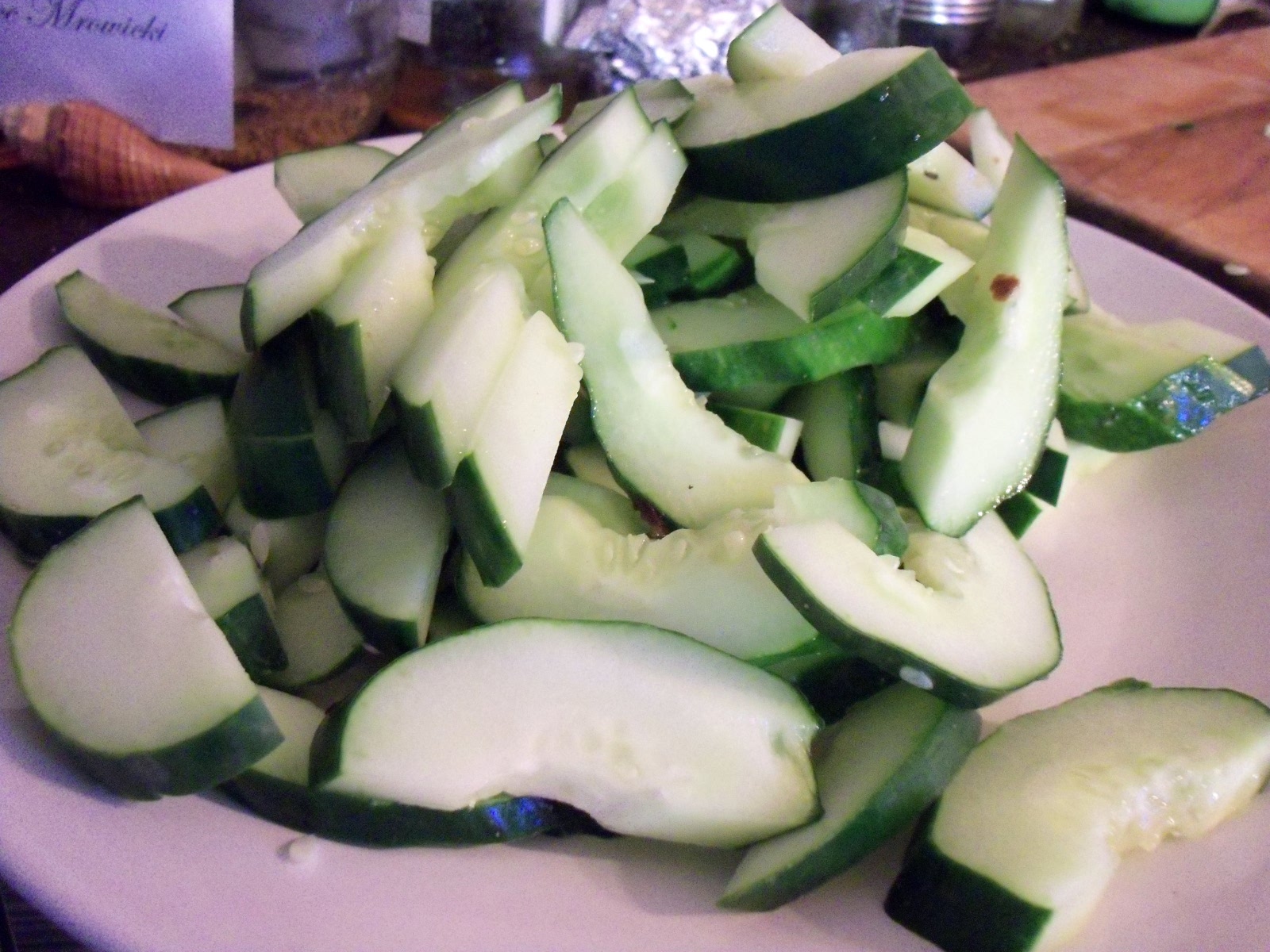
Two days later, a friend of ours showed up for dinner with a flat of fresh veg. from the farm where he's been living. He turns up occasionally with interesting selections of ingredients in search of a good home. Friends like this are good friends to have. This haul included a few pints of different tomato varieties, several colors of summer squash, a half-dozen cucumbers, some mismatched eggplants and a tiny, heart-sized watermelon. While compulsively munching little, orange, crack-laced tomatoes, we described a dish another recent dinner guest had shared with us that we found astonishing: hot cucumber salad. Something she had picked up in her travels in Western China, primarily Gansu province, the dish is hot in both senses of the word: served hot from the wok and liberally dosed with chili and garlic.

Up until then, it hadn't occurred to me to do a cooked dish composed primarily of cucumber; it seemed anathema to the vision of cucumber as cool, crisp crunch. Most of the hot cucumber I'd eaten involved throwing some into a fried rice in its very last moments on the stove, or including it al minuto in a brothy soup. This dish totally sold me on the idea, though. Remembering a languishing, slightly wilted half-head of greenleaf lettuce, we decided to add that, making it somewhat of a hot reimagining of a green salad. Also, it seemed a perfect foil to our plan for the second half of the fresh shiitakes, cooking them with Korean rice cake.

Korean rice cake (dduk) is a little like a giant, glutinous rice noodle (which, despite the name, is gluten-free), which we buy sliced on the bias into rounds. It has a thick, chewy texture and pairs well with all kinds of things. In fact, between that and gochujang, a thick, chili-based condiment that has been near indispensable in Korean cuisine since the introduction of chili in the 18th century, you have a kick-ass base for a stir fry which you can plug almost anything into. But that's a story for another day: gochujang would have overwhelmed the delicate little mushrooms.

Instead, we cooked the rice cake with a little bit of onion, oil and salt over high heat to get a little bit of toasty char flavor (contrary to what some may say, burnt is a flavor; you just probably don't want it to be the dominant flavor of your dish), took it out, cooked the mushroom similarly, and then tossed them together. And we saw that it was good. It's so simple, it's almost redundant to write a formal recipe to follow that.

    Hot Cucumber Salad

    vegan, gluten-free
    Serves 2-3
  • 2 med-large cucumbers, halved, seeded and bias-sliced med. thick
  • 3 cloves garlic, minced
  • 3 whole, dried red chilis, broken loosely
  • OR
  • 1 tsp. red pepper flake
  • 2 tsp. peanut or neutral oil
  • ½-1 tsp. salt

  • Optional:
  • 1 small head leafy lettuce, sliced into 1" strips
  • 1 Tblsp. rice vinegar
Prep vegetables. Heat wok over high heat. Swirl in oil. Add red pepper and about half the garlic. Tossing until the garlic smells toasty, about 10 seconds. Add cucumbers and toss. Sprinkle with about half the salt. and toss occasionally until cumbers start to get slightly soft, about 2-3 minutes. Add lettuce and vinegar, sprinkle with remaining salt and garlic. Toss to combine and cook until lettuce is somewhat wilted, 1-2 minutes.

    Shiitake & Rice Cake Stir Fry

    Vegan, gluten-free
    Serves 2, unless you've been sitting around eating too many little tomatoes, in which case it may serve 3
  • ~1 lb sliced rice cake (½ the bag)
  • ½ med. sweet white onion, med. dice
  • 4 tsp. peanut or neutral oil
  • 1 tsp salt
  • 1 c. fresh shiitake, sliced
  • ½ c. baby bella/crimini mushrooms, sliced
Heat wok over high heat. Swirl in 2 tsp. of the oil and add half the onion. Toss and add the rice cake. Sprinkle with half the salt. Toss/stir occasonally, letting the rice cake get a few charry speckles and the onion get a little soft, about 5 minutes. Remove to serving bowl.

Swirl in the other 2 tsp, of oil, add mushrooms and remaining onion. Sprinkle with remaining salt. Stir/toss until mushrooms & onions start getting soft, 3-5 minutes. Turn off heat, add rice cake back to wok and toss until combined.

LinkWithin

Related Posts Plugin for WordPress, Blogger...