Showing posts with label fresh. Show all posts

Tuesday, July 8, 2014

Peanut Noodles with Spring Greens. And an Egg.

For what it's worth, I wasn't complaining about the cold in February. Complaining about the dark, maybe. I save my temperature complaining for when it's hot out. It pairs well with my cantankerous stubbornness about air conditioning. Today peaked at 95°. Certainly not as hot as it can get around here, but just as certainly beyond comfortable.

Regardless of how warm it was today, here or where you were, we all have those days where the mere thought of turning on the stove makes you want to get another icy drink out. I've been realizing how much peanut sauce is a hot-weather staple for me recently: Fresh summer rolls dipped in it, drizzled over lettuce-wrapped rice (with or without anything else), or even just a bowl of veggies and a jar of peanut sauce.

This has been the recipe I've come back to more than others recently. Here, the peanut sauce dresses up cold buckwheat noodles tossed with long, thin cut cucumber or summer squash (inspired by zucchini noodles) and the piquant blend of greens I've been gradually thinning out of my garden. And ,just for good measure, an egg on top. Since discovering steam-cooked hard boiled eggs (a method which I can't recommend heartily enough), I've been putting them in all kinds of things. I'll let The Food Lab go into detail about the method, but by way of my recommendation, it is faster than other boil methods (since you only have to wait for ½" of water to come to a boil), and I have had an almost perfect peel record with it. The closest thing to an imperfect peel I've had since starting to use it is actually in the photos of this dish, and I'm pretty sure that one was my fault.

It's pretty good without the egg, too, though, and is totally vegan without it. If you're not eating eggs for whatever reason, the peanut sauce does provide a little protein, but I've also made and enjoyed this with crispy-fried bits of tempeh.

Peanut Noodles with Spring Greens

2 servings
  • 100 g soba noodles (one bunch)
  • 1 cucumber or small summer squash/zucchini
  • ¼ c. peanut sauce (see below)
  • 2-3 c. mixed baby greens (1-2 good handfuls per serving)
  • 2 eggs, boiled (or steamed!) to your preference (I like about 8 minutes here)
  • optional but nice:
    • scallion, sliced thin
    • a few sprigs of cilantro


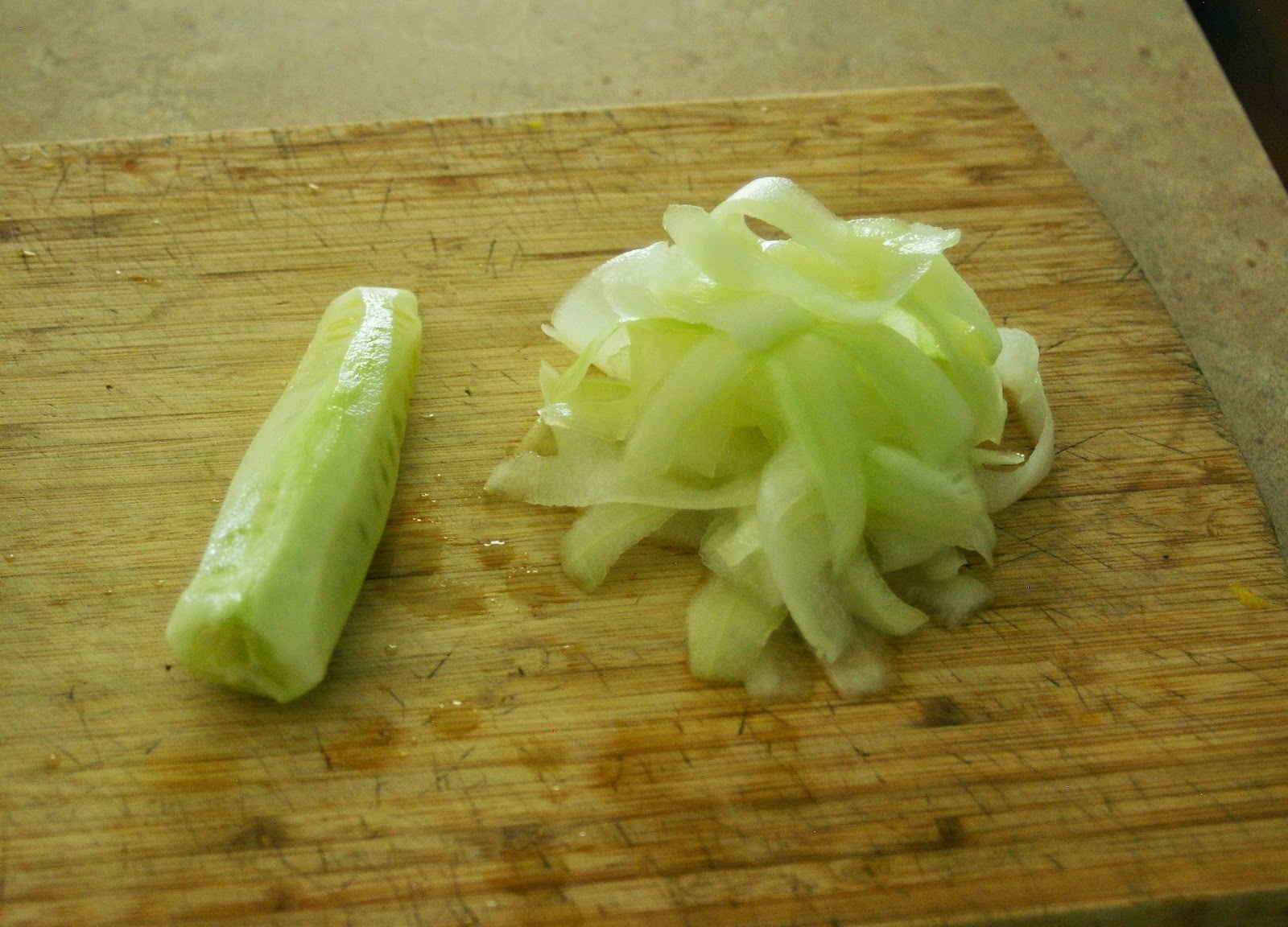
Start by putting on water to boil the noodles and cook the eggs (if you've got time, you can use the same pot and do the eggs after the noodles). While the water is heating up, peel your cucumber or squash. They're both very tasty here, and bulk out the noodles with cool fresh flavor. If you've got a spiral slicer or julienne peeler, good for you. You know what to do, so go to town. Otherwise, use your vegetable peeler to peel thin slices off of the cucumber or squash until you get down to the seeds. If you prefer, you can slice these strips thinner to blend in with the noodles more.

Once the noodles are cooked, make sure to run cool water through them until chilled. Toss the noodles and cucumber/squash in the sauce until well coated. Divide up into bowls and toss with a handful of greens, then top with an egg.


Peanut Sauce

vegan, gluten-free depending on your soy sauce
makes about 1 cup of sauce
  • ¼ c. peanut butter (Mine is creamy, natural & salted. Yours will work too, but you might have to add more or less stuff)
  • 1-2 Tblsp. sugar
  • 1 clove garlic, minced
  • 1 tsp. minced fresh ginger
  • ½-1 tsp. thick chili-garlic sauce like Sriracha or sambal oelek
  • (or more, to taste)
  • 2 Tblsp. soy sauce
  • ¼- c. water
Add all ingredients except water. Add water a tablespoon or so at a time, stirring until thoroughly combined before adding more water. If you add too much water at once, the suspension will break and you'll get weird thready peanut-butter bits in seasoned water. If this happens, add a little more peanut butter and stir until smooth. You'll have to add more water later. Adjust seasoning as necessary.

Sunday, November 18, 2012

Everyone Wants a Piece of Falafel

Falafel is kind of a beloved sore spot in the pervasive Palestinian/Israeli culture war. 2005's Oscar-winning short film, the comedic musical West Bank Story imagines the feuding parties of its source material as competing falafel joints: the Jewish-run Kosher King and the Arab-run Hummus Hut. When Larissa Sansour and Oreet Ashery, British-based artists of, respectively, Palestinian and Israeli origin, put together a project to examine the Israeli adoption of Palestinian culture and where the line between adoption and appropriation lies, they conducted it through interviews in London falafel restaurants and named it Falafel Road.

In fact, taking it back a step, you could probably teach an engaging and fairly comprehensive course in the history of the Middle East based entirely on the chick pea. Although some archaeologists speculate that the legume in question was first tamed by people living in northern India, the oldest archaeological evidence of cultivated chick peas comes from Tell El-Kerkh, in Syria, which date to the late 10th millenium BCE. The oldest evidence of the chick pea in Israeli/Palestinian territory dates to only about 1500 years after that (still over 10,000 years ago), at a site near Jericho in the West Bank.

However one might wish to, you can't infer falafel from the presence of chick peas, and foods like that don't preserve as well over time as dry beans (partially because that would require leftovers). So we'll skip ahead just a little to another important event in the history of falafel: the foundation of the state of Israel in the mid-20th century. A large influx of people and a shortage of meat pushed cheap protein like beans to the forefront for everyone in the region. Joan Nathan, author of Foods of Israel Today credits the contemporary, chick pea-based form of falafel to Yemeni Jews. Nathan claims that local falafel recipes in the pre-Israeli period tended towards a blend of chick pea and fava bean (also called broad
bean), as do many Lebanese falafel recipes. The local push away from fava beans, she argues, came as a result of Kurdish and Iraqi Jewish immigrants, many of whom suffered from favism, a serious, genetically-based enzyme deficiency that makes fava bean consumption (among other things) cause severe anemia. Local Palestinians claim that the only change to falafel is the Israeli flag on a toothpick stuck in it. Aziz Shihab, the Palestinian-American author of the cookbook A Taste of Palestine, wrote to a falafel-slinging Israeli restaurant in the States, "This is my mother's food, this is my grandfather's food. What do you mean you're serving it as your food?" Interestingly, yet a third claim on the provenance of falafel maintains that it was developed by Coptic Christians in Egypt for Lent, during which many Christians traditionally abstain from eating meat. Egyptian falafel, which they usually call tamiyya, is typically made entirely from fava beans rather than chick peas. Susan Molthen, executive chef of Bay Area Egyptian restaurant Al-Masri says, "Every region, city or country in the Middle East has it, but it's all derivative; they put their own spices and flavors into it."

I'm not going to try to make any conclusive claims about who originally invented the falafel; food is an artistic pursuit that demands an essential tension between the established and the subtly innovative and at the same time is a projection of culture deeply tied up in people's sense of identity. The truth is that it belongs to all of these people, but that their attachment to it doesn't make it belong to the others any less. It's yours if you make it, too, but significantly more so if you start with a bag of chick peas than if you start with a box of falafel mix. Because all of the many claimants can agree about that being an abomination.

The process isn't hard, given a little forethought and a food processor; it requires overnight soaking of dry chick peas (or at least several hours), but the process from there amounts to throwing everything in the food processor and buzzing it into a grainy paste, rolling it into balls and, finally, frying them. Deep-frying is traditional, but you can squash them into patties and pan-fry, too. Beyond that, all it requires are a few accoutrements: flatbread, fresh vegetables and tahini sauce. I also included some pickled radish after reading a number of recipes that suggested pickled vegetables, most commonly mango or turnip. Additionally, you can freeze the mixture uncooked, after rolling it into portioned balls: lay raw falafel on a cookie sheet lined with waxed paper or plastic wrap, cover lightly and freeze until the falafel is frozen enough to hold its shape. Transfer to a freezer bag, then pull out a couple at a time as you want them.


Falafel

vegan, optionally gluten/grain-free
makes 15-20 falafel
  • 1 cup dried chickpeas, soaked
  • ½ large onion or 1 small onion, roughly chopped (about 1 cup)
  • ¼ c. rough-chopped fresh parsley (a small handful)
  • ¼ c. rough-chopped fresh cilantro
  • 1 tsp salt
  • ½-1 tsp. red pepper flakes
  • 4 cloves of garlic
  • 1 tsp. ground cumin
  • 1 tsp. baking powder
  • 4-6 Tblsp bulgur* (optional)
  • oil for frying (I fry in ½-1" peanut or canola oil in a cast iron skillet on med. high heat)
  • *Gluten/grain-free advisory: Bulgur is a wheat product. It adds a really nice texture and is nominally there to aid in binding the falafel, but many traditional recipes are totally grain free, so feel free to omit this if you don't eat it or simply don't have it.

To soak the chick peas, you can either set them up the night before or start an hour or two before you want to serve. Put the chick peas in a large bowl or pot and cover with 2-3 inches of water. You can let them sit overnight or bring them to a boil for 2-3 minutes, turn them off and wait an hour or two. I've gotten better results with the overnight soak, but the expedited soak works fine if you decide you need to eat falafel today and give a far better result than canned, cooked chick peas.

Drain and rinse chick peas, prep ingredients as indicated and grind in food processor to a grainy paste. Roll into balls about 1½ in. in diameter (may require squeezing to hold together). Heat oil in pan over med-high heat until a little water sizzles and pops aggressively and put as many balls of falafel as you can at one time into the pan. I typically use my smaller, 8" cast iron skillet to do this. It fits 8 or 9 at a time, as they can be pretty close together, and uses up a lot less oil than do the larger pans I usually think of first. Fry until deep brown on one side, then turn. Drain on newspaper or paper towel. You can also put in just enough oil to coat the bottom, flatten the balls a little and fry them that way. It's not quite the same, but somewhat more practical if you're only frying up enough for one or two people.

The Sides

yogurt-tahini sauce:

  • 1 c plain greek yogurt (used 2% milkfat)
  • 1/4 c. tahini
  • 1 clove garlic, finely minced
  • 1 T lemon juice
  • 5-6 mint leaves, minced
  • 1/2 tsp. cumin
  • 1/2 tsp salt
  • 1/4 c. water

Tahini Sauce:

  • 1/4 c. tahini
  • Zest & Juice of 1 lemon (or 3-4 Tblsp. bottled lemon juice)
  • 1/4. c. water
  • 1/2 tsp. Salt
  • optional:
  • ½ tsp. hot smoked paprika
Both of these also make great vegetable dips. In fact, it's worth cutting up some extra veggies and putting them out with the sauce for diners to munch on while they're waiting for their falafel.

Wednesday, August 15, 2012

Quick Hits: Lentil, Herb & Feta Stuffed Tomatoes

The months of drooling, rhapsodic fantasies about perfectly-ripened field tomatoes have finally given way to a flood of them. It's not an overabundance; that would imply too much. The simple joy of slicing a tomato, sprinkling it with salt and maybe drizzling a little olive oil over it hasn't gotten old yet, but there's so much more to do with tomatoes before you even get to cooking them. I tossed together this fresh-stuffed tomato using some left over odds and ends recently and was so excited about it that I had to recreate it and write it down to share.

The dish is built around a protein-rich lentil and grain stuffing, simply flavored with a healthy handful of fresh herbs, a little feta, and the guts of the scooped-out tomato. It may look like a salad, but it eats like a meal.

Monday, July 30, 2012

Raw-Pack Canning Blueberries in Juice

Yesterday marked the 6th annual Boston Skillshare, and the third that I have been involved with. The last two years, I facilitated workshops on reclaiming yarn, basic auto maintenance, and beginning ukulele. Apparently, I can't stop teaching, even on weekends and vacations. This year, I facilitated a workshop on canning and pickling, by request. I had originally wanted to walk through canning tomatoes, but we have not quite reached the deluge of tomatoes that will be here in a week or two, so I went with blueberries instead. Blueberries are a particularly easy food to can: they don't need to be cooked or cut up ahead of time, and are sufficiently acidic that they don't need to be processed under pressure. I also had the privilege of being introduced to the League of Urban Canners, a group operating in the Boston area (primarily Somerville and Cambridge) to make the most of backyard fruit. If you invite them, they will come to your house, pick the fruit before it falls all over your yard, can it, and give you 10% of what they can. It's a really interesting model that I would love to be involved with if they weren't 2 hours away.

Before we start in with the blueberries, a few words about the role of heat and acidity in safe canning. The whole deal with preserving is to arrest, avoid or carefully control the bacterial and enzymatic breakdown of fresh food. These include such options as freezing, drying, fermenting and canning. Canning preserves food by sealing it away from the air under vacuum and killing any bacteria trapped inside through heat, which works for the vast majority of bacterial species. Clostridium botulinum is a more complicated story. While live C. botulinum are killed at boiling water temperatures, they produce spores which aren't. The spores remain active at that temperature and thrive in an oxygen-deprived environment at between 40°-140°F, (like, say, a can at room temperature) happily producing deadly neurotoxins. The spores can be destroyed at temperatures of 240°F. However, an acidic environment with a pH of <4.6 inhibits these spores, so that the live-bacteria killing 212°F is sufficient. This pH of 4.6 marks the dividing line between high-acid foods, which can be safely processed in a 212°F boiling water bath and low-acid foods, which must be processed using a pressure canner, which can reach temperatures of 240°F.

Blueberries, along with all other berries and the majority of fruits (by the common rather than botanical definition) are classified as high-acid foods, and can be processed in a boiling water bath. The general process for canning berries is as follows:
  1. Obtain berries.
  2. Wash berries.
  3. Load berries into sterilized jars.
  4. Cover with hot juice, syrup or water.
  5. Seal with lid.
  6. Process in a hot water bath for 15-20 minutes.

Monday, June 25, 2012

Eating the Bike Path: Grape Leaves


The grape may not be gathered from the birch?
It's all you know the grape, or know the birch.
As a girl gathered from the birch myself
Equally with my weight in grapes, one autumn,
I ought to know what tree the grape is fruit of.

—Robert Frost, "Wild Grapes"

The idea of foraging for wild edibles somewhat romantically evokes trekking deep into the wilderness, but the reality is both more and less romantic: edibles are all around. They are in your backyard, in the park and even growing up through the cracks in the street (which, though tenaciously lovely, you probably don't want to eat). My favorite place to gather wild edibles is the Manhan Rail Trail here in Easthampton. Within a half-mile stretch, you can find chicory, garlic mustard greens, dandelion, blackberries, lamb's quarters, pokeweed, japanese knotweed and grape leaves. There's probably more that I can't readily identify, too. These vary in how accessible they are to eat: blackberries and garlic mustard greens can be eaten on the spot, while pokeweed must be picked very young and boiled (I haven't gotten to eating this one yet, but I have harvested its berries for dyeing purposes). Many of these plants thrive in sunny roadside environments, but best foraging practices recommend collecting edibles at least 20 and preferably 100 feet away from the road. This is what's beautiful about the bike path: it has all of the sunny growing and easy-access benefits of the roadside, but without the exhaust fumes.

Friday, September 16, 2011

Quick Hits: Panzanella

We have kind of a unique problem - we have too much artisan bread hanging around on a regular basis. Maybe it sounds a little less whiny if I tell it like it really is: we have too much half-stale artisan bread hanging around. Maria works most of the week as a farmstand muffin and cookie-slinger, but one night a week, she puts on her cape and cowl and takes on her real passion: bread. Every Monday, after working a full shift at the regular baking job, she heads out at 11 o'clock at night to go shape bread at El Jardín, one of a few local bakeries that focus on wood-fired, sourdough bread. She returns, half-delirious, at about 9 o'clock in the morning, often towing several loaves of day-old sourdough, and proceeds to sleep for most of her Tuesday off (and then wakes up in the afternoon and commences cooking again for her weekly pot luck).

Bread, especially sourdough, is kind of a family legacy. We grew up with perpetual sourdough. Mom began baking when pregnant with me, and, for several years, plied her bread at the Brattleboro Farmer's Market out of the back of the 1970s Volvo with her spokesbabies. When I was about 5, she got a job baking in the kitchen at The Putney School, where she was encouraged to further develop her sourdough wiles. We also grew up in the back of that kitchen, warming ourselves against the huge, ceramic-lined ovens and sampling whatever came down the pipeline. As such, we grew up with the idea the sourdough wasn't a big deal. Folks' ability to normalize their childhood is remarkable sometimes. All that said, we only eat so much bread before it becomes almost unslice-ably stale. I guess it's better than it going moldy, with which you can do very little, but we store it at room temperature and not in plastic, which will get you stale over moldy most days. For better or worse, once bread has gone totally stale and lost all its moisture, it really won't go moldy.

So, we end up swimming in stale sourdough, and having to find creative ways to use it up outside of making breadcrumbs in quantities of epic proportion. Leading up to the end of summer, here's a quick favorite: Panzanella, a quick, Italian bread-tomato-basil salad full of simple, fresh, summery flavors that we always have trouble not picking to death before it makes it to its destination (the same can be said of another favorite stale bread usage, a savory bread pudding, but that's a story for another, cooler day).


    Panzanella

    vegan, about 20 min. start to finish
    serves 4-6
  • 1 loaf half-stale bread, large dice
  • 2 med-large tomatoes, large dice
  • 3-4 cloves garlic, slivered
  • ¼-½ c. olive oil
  • 1-2 tsp. salt (this is a good opportunity to break out the good salt)
  • 3-4 stems (15-20 leaves) fresh basil, chiffonaded
  • fresh ground black pepper to taste

  • Optional:
  • 1 chile, seeded and minced
After prep, toss all ingredients save the garlic. Toss garlic in a skillet with some of the olive oil over med-high heat until it starts to smell toasty, then sprinkle on top. Let sit for as long as you can stand it, or at least 15 minutes. Crank black pepper to taste over the top.

LinkWithin

Related Posts Plugin for WordPress, Blogger...