Showing posts with label local. Show all posts

Friday, May 23, 2014

Don't Step on the Grass...

But no, not that grass in the lawn. And, no, not that either.

You may know it as asparagus, but come mid-May around here, it's simply grass. Hadley grass, to be specific. Hadley, on the rich floodplains just across the Connecticut River and hair north of here, is world-renowned for its asparagus. Or at least it was, up until the 1970s, when a soil-borne fungus more than literally decimated Hadley's asparagus production. In the decades leading up to that, Hadley farmers would pick and prepare up to 50 tons of asparagus each day of the fleetingly brief few weeks of the season. Hadley grass reportedly turned up in chic European restaurants and even at springtime feasts held by the Queen of England.

Although local asparagus production doesn't take on the epic proportions it did forty years ago, there are still a handful of asparagus farmers in full-scale production and many backyard growers with extra to sell. The town still takes pride in this element of its history, honoring the tender green spears with a major community festival and, I kid you not, an ice cream flavor. And, as it's an ingredient where freshness is especially rewarded, it's still worth trawling the back roads in Hadley and the surrounding towns this time of year for hand-written signs that simply read "Grass." Or, if you're me, quietly coveting the asparagus in the adjacent community garden plot and settling for taking many pictures of it and then buying a bunch from the stand just up the hill.

So, why simply grass? One variant, based on a folk etymology of the word, dating back to the 17th century, was sparrowgrass. The name held on until late in the 1800s, and, according to a 1791 pronunciation dictionary, calling it "asparagus" implied "an air of stiffness and pedantry." I can't say for certain why it stuck around here, but even aside from a desire to avoid stiffness and pedantry, it was grown in sufficient volume that it was almost as common as that grass in the lawn.

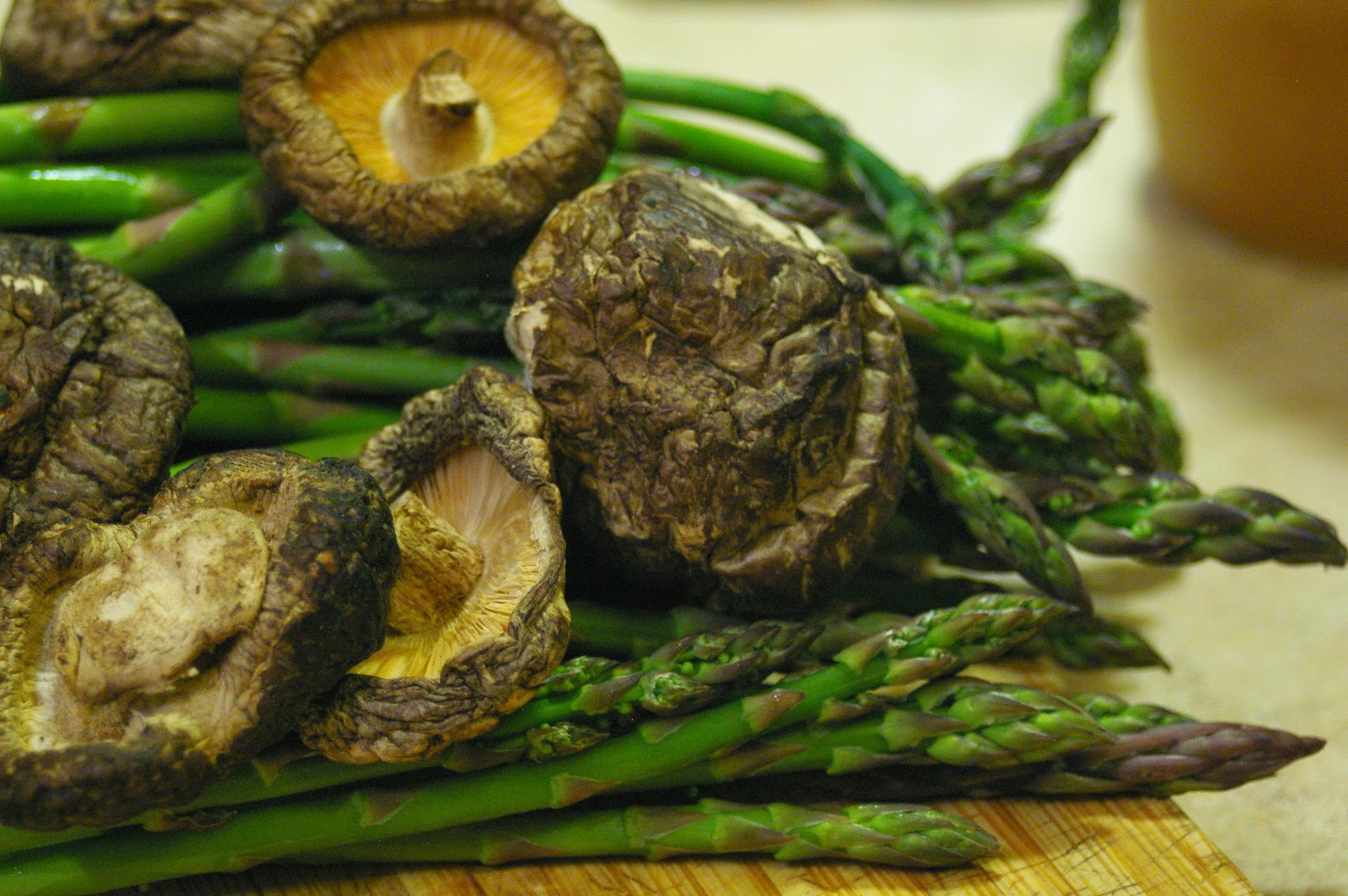
Asparagus being as versatile as it is and asparagus season being as fleeting as it is, I've been chowing through it every which way since the first local asparagus came in about two weeks ago. I was thinking of writing about asparagus and chèvre risotto or lemony shaved asparagus salad, but today's cool, rainy weather put me in a soup mood so I put together a creamy, smooth asparagus soup, accented with dried shiitake mushroom and white wine and topped with the asparagus tips, toasted with slivered garlic.

Creamy Asparagus-Mushroom Soup

gluten/grain-free, optionally vegetarian
  • 1 lb. asparagus
  • 1 onion, small dice
  • 4 cloves garlic
  • 6-8 dried shiitake mushrooms
  • 1 Tablespoon butter
  • 1 teaspoon olive oil
  • 2 teaspoons salt
  • 1¼ c. dry white wine
  • ½ c. cream
  • 2 c. chicken or veggie broth
You have two options with the dried shiitakes: you can grind them up and add them as a powder, or you can simmer them in the stock until they're soft enough to blend. If you're simmering them in stock, start that first. Break up the mushrooms coarsely with your hands and put them in a small saucepan with the broth and bring up to heat over medium-high heat. The mushrooms will need to simmer for at least 15-20 minutes to soften. If grinding them up, run them through a spice grinder until fine and set aside.

Dice onion. Melt butter with olive oil in a large saucepan over medium-low heat, then add onion, stirring occasionally. Meanwhile, peel and mince two cloves of garlic and prep the asparagus. Snap off both ends of the asparagus (this is a good job for earnest helpers of all ages and abilities). If you're running short on time, you can cut off the top and bottom inch of the spears in one fell swoop. Scrap the cut ends, but put the tips aside to put on top later. Cut the stalks into pieces about an inch long.

Once the onion has started to get clear and soft, add the garlic, salt and asparagus. Stir until the garlic gets fragrant, then add a cup of wine. If simmering mushrooms, add the mushrooms and broth, too. If using ground mushrooms, whisk with the stock and add to the pot with the asparagus. Let simmer until the asparagus is soft, 10-15 minutes, add the cream and remaining wine, then blend until smooth.

Sliver the other two cloves of garlic and saute in a little olive oil with the asparagus tips and salt and pepper. Serve soup with garlicky asparagus tips on top.

Monday, October 29, 2012

Pumpkin Caramel Profiterole

Let's talk about cream puffs. No, let's talk about squash first. I've eaten winter squash, in one form or another, for the last five days. The only problem with this is that I am currently out of squash.

Too many people go straight for cutting winter squash in half, adding butter, brown sugar and cinnamon and baking. There's nothing wrong with that, but squash can do so much more. In the last week, I have eaten squash in a Mexican-style rice bowl with beans and rice, a South Indian-style coconut and chick pea curry, on flatbread with eggs and tomato jam, in macaroni and cheese, and in cream puffs. And, of course, plain by the spoonful. It is no coincidence that asquash, one of the Algonquin roots from which the English word squash derives, simply means "eaten."

Roasting squash really is the only way to cook it: simmering it leaves it with a stringy texture and can sap out the flavor and copious nutrients. Roasting, on the other hand, enriches a squash's sweetness and creamy texture. I like to roast squash ahead of time, even when I'm not going to use it immediately, often a few at a time. As long as you're going to be at home for an hour, you can roast a squash. It doesn't need much attention while cooking. It keeps in the fridge for two weeks or so (in the unlikely occurrence that it sticks around that long) and provides instant squashy gratification.

To roast any variety of winter squash, turn on the oven to 375°; cut your squash in half and scoop out the seeds. The seeds, of course, can be roasted on their own for a toasty snack. Lay the halved squash cut side down on a lightly oiled sheet pan. Use foil if you don't feel like soaking/scrubbing later. Let it cook until squash is tender to the touch and the skin has started to brown up some. Depending on how large your squash is, this could be anywhere from 35-60 minutes. Set a timer for 30 minutes, poke the squash at its thickest point and decide how long you want to set the next timer for based on your squash-poking assessment.

Don't be too rigid in your squash variety selection, either. You may have a recipe for butternut squash soup or pumpkin pie, but you may find that you like the reverse, or that buttercup makes the best ravioli filling or that you are a fiend for hubbard squash in any form you can get it. A friend living in Germany for the year is finding that the only variety she can get, Hokkaidokürbis (Hokkaido, red kuri or baby red hubbard squash), works really well in places she'd expect to use pumpkin or butternut. A guide to about a dozen popular winter squash varieties is available here.

But enough about that. Let's talk about cream puffs, or profiterole, which is a fancy word which refers to anything creamy stuffed in a pâte à choux shell, usually ice cream or whipped cream (cream puffs typically involve pastry cream). The choux paste shell seems to have fallen out of favor in recent times. This is really a shame; they're a versatile vehicle for flavors sweet and savory. And when you think about it as basically making baked bubbles—which it is—making the shells themselves becomes magic even before you fill them.

Which brings us back to roasted squash. If pumpkin pie season can't come soon enough for you, take note: pumpkin profiterole. Or, whatever kind of roasted winter squash you have profiterole. In fact, unless you're starting with a premade crust, these can be ready faster than a pumpkin pie. Moreover, pâte à choux is not appreciably more fussy than a pie crust (Warning: making pâte à choux can be habit-forming). Also, they look way more impressive, especially when you add a drizzle of caramel. The filling is a mixture of roasted squash, brown sugar and the spices you would add to pumpkin pie, folded with a simple whipped cream. The overall effect is an ethereal few bites of creamy, spiced delight.

Pumpkin Profiterole

The recipe here is more a series of components rather than one recipe. After making the choux paste shells, squash filling and caramel, spoon or pipe the filling into the shells and drizzle caramel over the top. Serve promptly.

Pâte à choux

Adapted from Joy of Cooking
makes about 15 two-inch cream puff shells
  • 4 large eggs at room temp.
  • Dry mix:
  • 1 c. AP flour
  • 1/4 tsp salt
  • (optionally add 1 T sugar)
  • Wet Mix:
  • 1 c water/milk
  • 1/3 c. butter
Preheat oven to 400°. Sift dry mix together and set aside. Heat wet mix together in a large, heavy saucepan;
when it boils, add dry mix all at once and stir briskly, until it becomes a smooth paste and stops sticking to the sides and bottom of the pan. (see above)

Add eggs one at a time, beating thoroughly after each addition (some people like to do this in the food processor). Spoon or pipe the paste onto parchment-lined sheet pans in mounds about 1½" across, leaving room for them to puff up. Bake at 400° for 10 minutes, then turn the oven down to 350° and bake for another 25 minutes, or until quite firm to the touch. Gently stab each with a sharp paring knife to vent it so it cools enough to accept filling without melting it quickly.

Filling

  • 1 c. mashed squash (canned will also work)
  • ½ c. brown sugar
  • ½ tsp. salt
  • 1 tsp. cinnamon
  • ½ tsp. nutmeg
  • ½ tsp. ground ginger
  • ½ tsp. clove
  • ½ c. whipping cream
Whip cream. Blend all other ingredients and then fold into whipped cream.

Caramel Sauce

Recipe adapted from David Lebovitz's Ready for Dessert
Lebovitz's blog, Living the Sweet Life in Paris is always a good read as well.
  • ½ c. (1 stick) butter (salted or not, up to you), cut into pieces
  • 1 c. sugar
  • 1 c. heavy cream
  • ¼ tsp. salt, or to taste
  • Optional:
  • ¼ c. bourbon (a little more than a shot)
In a large heavy-bottomed saucepan (deep is important because it will bubble up pretty aggressively after the cream is added), heat the butter and sugar over medium heat. Stir occasionally until the sugar begins to caramelize. When it reaches a dark amber color and smells on the verge of burning, remove from heat and immediately add the cream. Stir until smooth, then stir in salt and bourbon. Letting the sauce cool to at least room temperature gives you a thicker, more caramelly sauce texture, but you can use it before that. Sauce can be stored for up to 2 weeks if refrigerated and a spoonful in a cup of coffee or black tea makes the world a beautiful place.

Saturday, September 29, 2012

Quick Hits: Herb Garlic Parmesan Potato Wedges

A sure sign of fall: potatoes are back! Boil 'em, mash 'em, stick 'em in a stew! Perhaps the biggest source of the potato's meteoric rise to culinary ubiquity in Europe has to do with how little need be added to reach being comfort food: little more than heat, salt and maybe butter. You can definitely add more (see last fall's breakdown of Potato Gnocchi with Leek, Kale & Sage Butter), but, as demonstrated by the recent excitement about Waffle-Iron Hashbrowns, the spud requires little help past heat.

Here, cheese and garlic help play up the warm, toasty potato goodness, adding a flavorful crustiness to a simple roasted spud.

Herb Garlic Parmesan Potato Wedges

vegetarian, gluten/grain-free
serves 4-5, about 30 minutes, start to finish
  • 3 lbs potatoes (red ones are nice, but not essential)
  • 2 T olive oil
  • 1 tsp salt
  • Topping:

  • 4-5 cloves garlic, minced
  • 6-10 sprigs thyme (or about 3-4 T)
  • fresh ground black pepper
  • ¼ c. grated parmesan cheese
Preheat oven to 450°F.

Cut potatoes into wedges (6-8 per spud) and toss with olive oil. Spread on sheet pan and sprinkle with salt and pepper. Bake wedges for 10-15 min.

While wedges are roasting, mince garlic and mix with other topping ingredients. Turn potato wedges, sprinkle with topping, and return to oven for about 5 minutes.

Saturday, August 25, 2012

Spicy Tomato Peach Jam: Convergent Evolution?

One of my favorite writers, magical realist godfather Jorge Luis Borges, has a short story, "Pierre Menard, Author of the Quixote" (in Spanish; in English), which describes the efforts of a writer to rewrite the classic Don Quixote. Menard wishes not simply to reinterpret the story in his own words, but to cause himself to produce Cervantes' exact text, even if only a few pages thereof. He rejects his initial approach, "[to] know Spanish well, recover the Catholic faith, fight against the Moors or the Turk, forget the history of Europe between the years 1602 and 1918, be Miguel de Cervantes," as too simple, and decides instead, "to go on being Pierre Menard and reach the Quixote through the experiences of Pierre Menard." For additional absurdity, the story is presented as an obituary of sorts for Menard, who never actually existed.

I was put in mind of this yesterday when I spontaneously recreated a recipe I had merely skimmed during initial research for a tomato jam I decided to make after coming home from the farm with an entire flat of tomatoes. Given, this is a much less onerous task than recreating Quixote; there's a reason you can't copyright a list of ingredients. And, in truth, a list of ingredients is not a recipe.

Thursday, August 16, 2012

Russian Eggplant "Caviar"

I recently lost my main Russian grocery hookup when the last of my stepmother's family pulled up roots from their largely Russian Northeast Philly neighborhood. Our shared background in Russian Studies has been a major bonding point for us. I first met her shortly before I started studying Russian towards the end of high school and she was a big part of my reassuring my parents that it was perfectly fine to send me off to Central Asian parts of the former USSR back in 2002, based on her own experiences in the USSR in the late 70s/early 80s (my parents have never leaned towards being overprotectively alarmist, but anywhere ending in -stan raised a high eyebrow that close to 9/11 and the beginning of US involvement in Afghanistan). A couple times a year, she'd call to say, "Hey, I'm going to visit my mom for a few days. You want anything from Bell's?" (referring Bell's Market, the go-to Russian store in Philly). We'd go on for a few minutes about all the different kinds of frozen dumplings, smoked fish, cold salads and baked goods available there, which inevitably turned into reminiscences of particular meals and dishes from our travels. Every culture has its notable culinary adventures, but Russian culture in particular seems to keep the kitchen table at its heart. I'm reminded of a toast in honor of the kitchen table from Dennis Danvers's novel, The Watch:
"The Kitchen Table...is the site of all that's best in Man—his sociability, his intellect, his good humor, and his generosity—not a monument to death but a celebration of living, not the theft of life but its sharing, not the jingoistic cant that generally passes for history but here and now, together in solidarity, this very moment! I give you: The Kitchen Table!"
This toast is delivered by none less than Peter Kropotkin, or at least a fictional, time-traveling version of him, though I could imagine a similar proclamation coming from the man himself.

In any event, one of the Russian specialties that we always lingered over was баклажанная икра (bak⋅la⋅zhan'na⋅ya i⋅kra'), which literally translates as, "eggplant caviar." For all that it's called "caviar," baklazhannaya ikra is a totally vegan "salad" (Russian salads rarely involve leaves) made of eggplant, tomato, pepper, onion and carrot slow-cooked together to savory perfection and seasoned with the only two herbs that really matter in Russian cuisine, dill and parsley

Saturday, August 4, 2012

Quick Hits: Pickled Radishes


When I teach square roots and other math involving radicals, I take great pleasure in putting little radishes on all of my handouts. It's a place where my odd sense of humor can bring together my nerdy loves of language, math and food. The point of connection is this: both radish and radical derive from the same Latin word, radix, meaning "root."

For all of my love of the linguistic spin-out of radishes, though, I'm a little lukewarm on eating them, at least the red European varieties. It's a little puzzling to me, because all of the words I put together to describe the flavor of such radishes are usually words common to foods I really like: spicy, peppery, mustardy, crisp. I like daikon radish fairly well, but it's almost more of a texture than a taste. What would the Fraggles think?

Earlier in the summer, I ended up with several bunches of radishes from my farm share and while dragging my feet and feeling bad about not using them, decided to look up pickled radish recipes. After reading a number of recipes, I put together a radish refrigerator pickle and hoped for the best. After letting them sit for a few days, I pulled them out. The bright color of the radish skin had leached out into the brine, giving it the vivid red tone of generic fruit punch. I tasted them and was initially disappointed: the radishy taste was still there, thinly veiled with salty vinegar. I put them back in the fridge, hoping, as with the fresh radishes, that they would magically transform into something I liked.

About a week later I was making some tuna salad and, on a whim, pulled out the radish pickles again, chopped some up, and added them to the salad, where they ended up being the star. Suddenly, I was looking for things to include them in. That was really the key: they go in things, not on their own. Since then, they have improved burritos, falafel, and a variety of cold salads. I'm almost out, and I may even go out and buy more radishes to make more pickles.

    Refrigerator Radish Pickles

    raw, vegan, gluten/grain-free
  • 1½-2 c. sliced red radishes (8-12 radishes, depending on size)
  • 5 cloves garlic, sliced or smashed
  • 1 c. cider vinegar
  • ½ tsp whole black peppercorns
  • ½ tsp. kosher salt
  • ½ tsp. sugar
Put the vinegar, salt and sugar in a pint jar, put the lid on and shake vigorously until salt and sugar are dissolved. Add sliced radishes, garlic and peppercorns. Replace the lid and put the jar in the fridge. Allow pickles to sit for at least 5 days before using.

Serve in a sandwich, falafel, or burrito or add to tuna salad.

Monday, July 30, 2012

Raw-Pack Canning Blueberries in Juice

Yesterday marked the 6th annual Boston Skillshare, and the third that I have been involved with. The last two years, I facilitated workshops on reclaiming yarn, basic auto maintenance, and beginning ukulele. Apparently, I can't stop teaching, even on weekends and vacations. This year, I facilitated a workshop on canning and pickling, by request. I had originally wanted to walk through canning tomatoes, but we have not quite reached the deluge of tomatoes that will be here in a week or two, so I went with blueberries instead. Blueberries are a particularly easy food to can: they don't need to be cooked or cut up ahead of time, and are sufficiently acidic that they don't need to be processed under pressure. I also had the privilege of being introduced to the League of Urban Canners, a group operating in the Boston area (primarily Somerville and Cambridge) to make the most of backyard fruit. If you invite them, they will come to your house, pick the fruit before it falls all over your yard, can it, and give you 10% of what they can. It's a really interesting model that I would love to be involved with if they weren't 2 hours away.

Before we start in with the blueberries, a few words about the role of heat and acidity in safe canning. The whole deal with preserving is to arrest, avoid or carefully control the bacterial and enzymatic breakdown of fresh food. These include such options as freezing, drying, fermenting and canning. Canning preserves food by sealing it away from the air under vacuum and killing any bacteria trapped inside through heat, which works for the vast majority of bacterial species. Clostridium botulinum is a more complicated story. While live C. botulinum are killed at boiling water temperatures, they produce spores which aren't. The spores remain active at that temperature and thrive in an oxygen-deprived environment at between 40°-140°F, (like, say, a can at room temperature) happily producing deadly neurotoxins. The spores can be destroyed at temperatures of 240°F. However, an acidic environment with a pH of <4.6 inhibits these spores, so that the live-bacteria killing 212°F is sufficient. This pH of 4.6 marks the dividing line between high-acid foods, which can be safely processed in a 212°F boiling water bath and low-acid foods, which must be processed using a pressure canner, which can reach temperatures of 240°F.

Blueberries, along with all other berries and the majority of fruits (by the common rather than botanical definition) are classified as high-acid foods, and can be processed in a boiling water bath. The general process for canning berries is as follows:
  1. Obtain berries.
  2. Wash berries.
  3. Load berries into sterilized jars.
  4. Cover with hot juice, syrup or water.
  5. Seal with lid.
  6. Process in a hot water bath for 15-20 minutes.

Friday, July 27, 2012

Super Zucchini Bread with Lemon, Walnut and Basil


In Vermont, we like to joke that the reason to lock your car in the summer isn't because someone might steal it, but because someone might leave a bushel of zucchini in the front seat. Delicate little fruits grow into baseball bats overnight and invite four or five friends along, too. My childhood memories of zucchini have as much to do with using them for benches and dressing them up in doll clothes as they do with actually eating them. Local fairs in zucchini-prone areas often turn up with events like best-dressed zucchini contests or zucchini races (see above). There's still plenty left over to eat. Besides, who's to say you can't eat your winning car?

For all that they are abundant to the point of ubiquity around here in the summer, I don't actually get tired of eating them. Zucchini (and all of its summer squashy cohort) are ridiculously versatile and, in a number of dishes, seem to vanish entirely (chefs for the vegetable-averse, take note). Zucchini bread is a good example of this.

My dad requested a good zucchini bread recipe the other day, specifically one that wasn't too sweet and used a lot of zucchini. A great many zucchini bread recipes really load up on sugar (and fat, for that matter). The top result for "zucchini bread" on Google contains 3 cups of sugar and 1 cup of oil to 2 cups of zucchini and 3¼ cups of flour in two loaves. That's a sugar-heavy ratio even by cake standards, and a disappointingly low zucchini content.

Wednesday, July 25, 2012

Swordfish with Peach-Corn Salsa


My CSA keeps me sane in the summer: it helps keep my miserly urges from denying me fresh vegetables and jump starts my culinary creativity in a couple different ways. Not only does the seasonality lead me into the diverse options for familiar vegetables, but it also forces me to try out vegetables I'm less familiar with (see the last post, a study of kohlrabi). This has worked really well for the last few yeas, and both my miserly urges and desire for a varied palate are satisfied.

This year, the farm down the road where I have a share became a pickup location for Cape Cod Fish Share. The fish share does the same things that the vegetable share does for me as regards creativity and circumventing the miserly urges, but also answers many of the sourcing and sustainability questions that keep me from buying fish regularly.

Wednesday, July 18, 2012

The Kohlrabi: Spherical, but quite pointy in parts!

What is Sputnik doing in my CSA share?!

One of the best parts of a farm share is the surprises: the chances to meet a new ingredient head on, figure out what makes it tick like a tasty bomb, and eat it up. Kohlrabi is one that I'm still figuring out, and the friends with whom I do farm pickup have been left scratching their heads as well. It's only in the share a once or twice out of the year, and each year has slowly revealed its charms a little more. This year, I think I finally have its number.

CSA-share head-scratch staple kohlrabi, which looks like a more organic version of Sputnik (spherical, but quite pointy in parts!), is part of the largely familiar Brassica oleracea crew, which includes kale, broccoli, cauliflower, Brussels sprouts and cabbage (but not napa cabbage or bok choy, which are Brassica rapa). It's remarkable to think that they're all the same species, but, then again, so are chihuahuas and Irish wolfhounds.

Monday, June 25, 2012

Eating the Bike Path: Grape Leaves


The grape may not be gathered from the birch?
It's all you know the grape, or know the birch.
As a girl gathered from the birch myself
Equally with my weight in grapes, one autumn,
I ought to know what tree the grape is fruit of.

—Robert Frost, "Wild Grapes"

The idea of foraging for wild edibles somewhat romantically evokes trekking deep into the wilderness, but the reality is both more and less romantic: edibles are all around. They are in your backyard, in the park and even growing up through the cracks in the street (which, though tenaciously lovely, you probably don't want to eat). My favorite place to gather wild edibles is the Manhan Rail Trail here in Easthampton. Within a half-mile stretch, you can find chicory, garlic mustard greens, dandelion, blackberries, lamb's quarters, pokeweed, japanese knotweed and grape leaves. There's probably more that I can't readily identify, too. These vary in how accessible they are to eat: blackberries and garlic mustard greens can be eaten on the spot, while pokeweed must be picked very young and boiled (I haven't gotten to eating this one yet, but I have harvested its berries for dyeing purposes). Many of these plants thrive in sunny roadside environments, but best foraging practices recommend collecting edibles at least 20 and preferably 100 feet away from the road. This is what's beautiful about the bike path: it has all of the sunny growing and easy-access benefits of the roadside, but without the exhaust fumes.

Thursday, November 3, 2011

Root-Beer Rarebit Soup: Ultimate Soup for Ultimate Soup Weather

So, as you may have heard, New England had a little snow last weekend.

And by a little snow, we mean a foot of wet, heavy stuff that downed large limbs and knocked power out for millions of people in the Northeast. Including us, for about three and a half days. Growing up, I always used to look forward to power outages; they were all about hanging out around the woodstove, playing cards with the family while drinking cocoa by candlelight. Some key details embedded in that sentence: woodstove, which implies heat; drinking cocoa, which implies ability to cook. As long as you have those two things, life goes on pretty much as normal, give or take having to refill the toilet tank manually from the gallons of water you keep specifically for times like this because the well pump runs on electric. As is, our apartment's heat and cook stove both require electricity to run, so we were without both.

So, we decided to revisit the idyllic side of the power going out and headed up to Vermont, after hearing we could be without power for up to a week (as of writing, Western Mass Electric reports that 26% of its customers - over 56,000 people - are still without service, though they have been working flat out since Sunday). We were planning on getting together on Sunday anyhow, to make dinner for Maria's birthday, so we just made a venue change and headed north. Sunday turned out to be a beautiful day - they mostly have been since the storm - clear blue skies and snow melting like it was going out of style. Ironically, the power in Vermont came back on Sunday afternoon, shortly after we got up there. We heard later that some friends from Northampton actually drove up to Brattleboro and rented a motel room to stay warm after returning home to no heat from a brisk weekend in New York, spent mostly outside.

Stopping by Mom's on the way home on Monday afternoon (my heat wasn't on, but it was at school, so they planned to be open Tuesday), she pressed some of the soup she had just made on me, and that soup has pretty much been the template for this week: Pumpkin. Cheddar. Beer.
It sounds like an obviously genius idea upon hearing it; the ultimate soup for the ultimate soup weather. Since then, I've been adapting it to accommodate the variety of sweet winter vegetables that predominate this time of year. Both recipes are adaptations of Mollie Katzen's "Pumpkin Rarebit Soup" from the classic Hippie-American cookbook The Enchanted Broccoli Forest.

Our CSA farm's winter squash crop, planted on the banks of the Connecticut River, was drowned by flooding during Hurricane Irene. However, this year marked their best harvest of sweet potatoes ever, so sweet potatoes have been doing double duty for us in many of the places that we would typically use squash (unfortunately, they don't make very good jack o'lanterns). We offered to cook dinner for some friends in Northampton, with whom we stayed two nights after their power came back online before ours, to thank them for their hospitality.
They let us know that in addition to our sweet potatoes, they had a whole mess of leeks and parsnips they weren't sure what to do with, so they went into the soup, too. Pretty much any sweet fall vegetables will work: winter squash, sweet potatoes, parsnip, carrot, turnip, etc. I picked up a bunch of the perennial favorite Smuttynose Old Brown Dog, a brown ale which balances well a nutty caramel maltiness with a crisply hopped flavor and which actually has its origins in Northampton, to go in and with the soup. I also amped it up a little with the addition of my old friend chipotle and came up with a soup that merited three bowlfuls from at least one diner.
Sweet fall vegetables. Cheddar. Beer.

Root-Beer Rarebit Soup

vegetarian, serves 4-6
  • 1 leek, halved and cut into ½" thick half-rounds OR 1 small onion, medium dice
  • 1 Tblsp. butter
  • 1 qt. mixed sweet fall vegetables, cut into about ½" cubes ← you can also use roasted vegetables here for a quicker soup
  • 1½ c. (12 oz.) beer (I used a brown ale, Katzen recommends a lighter ale, you know what you like)
  • 1½ c. water or stock (vegetable or chicken)
  • 1 heaping cup grated sharp cheddar cheese
  • 1 tsp ground, dried chipotle OR 1 canned chipotle in adobo, minced (optional)
  • salt and pepper to taste
In a 3 qt. or larger soup pot, melt butter and begin cooking leeks or onions over med-low heat. Lightly salt. I like to start this process, then start prepping the rest of the vegetables just to make myself patient and give the leeks/onions enough time to cook soft. Add the vegetables. If you're using roasted vegetables, you can add the beer/stock/water immediately. If using fresh, you want to give them about 15 minutes to cook before adding liquid. Once the vegetables have started to get soft (almost immediately for roasted, and about 30 min for fresh), blend until smooth. Add grated cheese and stir until melted and combined. Add chipotle, if using, adjust salt and pepper and serve, ideally with more of whatever beer went into the soup and with a bread robust enough to match (Hungry Ghost Bread, which bakes in a wood-fired oven was one of the first and only places open on Sunday. They had lines out the door for hours.)

Monday, October 10, 2011

Freedom Eggs: Protein, History and Good Karma, together at Last (Kunming Tomato and Egg)

We recently started getting eggs from a family at the school where I teach. Local eggs are something I'd been meaning to catch up with for a while, but despite my good intentions driving by "Fresh Eggs" signs alongside the road, it hadn't happened yet. So when I saw a flyer in the school lobby advertising weekly delivery to the school, I was sold. Someone's going to bring me a dozen eggs every other week at school? Awesome.

The family farm in question is an interesting place. It's on the site of the Ross Farm in Florence, MA, the last remaining building of a center of 19th century abolitionist and civil rights activism and stop on the Underground Railroad. At various points in that epoch of its history, it played host to such historical figures as Sojourner Truth (one of Florence's most celebrated historical residents) and Frederick Douglass, who was a frequent lecturer there.

These days, the farm is the family homestead of the Walker/Hammarlund clan, and also plays host to an herb farm run by another couple. I first caught wind of their project shortly after a play about local abolitionists by the class of one of their kids used a field trip to their house as a narrative framework. Someone mentioned that they were gearing up to start doing egg delivery by donkey cart. As if this operation needed to be any more stylish (donkey cart delivery is only available within Florence).

Shortly before the beginning of the school year, the farm was impacted by flooding of the Mill River caused by Hurricane Irene, which came up fairly suddenly and found them literally tossing chickens out of the barn to keep them away from the rising floodwaters.

In any event, we've been enjoying the eggs. I cracked open a double-yolker earlier today. However, going through a dozen eggs in two weeks is a quicker pace than we're accustomed to. It will pick up when I get into serious soup for lunch season and start including eggs in my lunch more often than not. In the meantime, this very simple dish has saved the day from the cranky hungries (or "the hangries" as we call it) a few times over the last few weeks. While any number of cultures have their own simple dishes focused on egg and tomato, this is one Maria learned from her Chinese professor in college, who was from Kunming in the southwestern Yunnan province (fun fact! in Mandarin, the word for tomato directly translates as "barbarian eggplant"). It's little more effort than plain scrambled eggs, but so much more satisfying.

Kunming-style Tomato and Egg

vegetarian, gluten-free
serves 1, 10 minutes start to finish
  • 2 eggs
  • 1 small or ½ large tomato, large dice (or a small handful of cherry tomatoes, halved or quartered)
  • 1-2 scallions, sliced into rounds
  • OR
  • 1 clove garlic, minced
  • 1 tsp. soy sauce
  • ½ tsp. sugar
  • ¼-½ tsp. salt
  • a drizzle or spritz of oil to grease the pan
Crack eggs in a bowl and whisk with a few pinches of salt and about half the sugar. Prep the tomatoes and scallions/garlic. Heat pan on med-high heat. Add oil and the garlic or half the scallion. Give it about 30 seconds to start smelling toasty, then add the egg. Start cooking it in an undisturbed sheet, as for an omelet. Pull up the sides every so often and tip/swirl the liquid egg out to the edges to cook. Once it's mostly set, break it up and add the tomato, soy sauce and remaining scallion and sugar. Serve hot on its own, over a little rice or with a piece of toast.

Thursday, September 29, 2011

Spuds: Gnocchi with leek, kale and sage butter

From the Potato Festival at Sentry Hill Historic House, UK

Potatoes are starting to come in from the farm, and so I've been giggling about potatoes a lot recently.

Why are potatoes so damn funny, anyway?

Way back when I was an active linguistics major, a friend and I half-seriously started developing a phonetic theory of humor. Which is to say, determining which sounds produced by the human vocal tracts and which features of them were inherently funny. We compared oodles of words that made us giggle. We looked at beautiful sounding things, like cellar door, and inverted their qualities. We combined a number of funny features and found ourselves in a Swedish Chef routine. I don't remember everything about our inquiry and findings, but as far as I remember, it doesn't quite predict the humor of potato. It doesn't have any awkward consonant clusters, its vowels display one or fewer of the funny features (high, front, rounded). Still, again and again, it comes up as hilarious, context or no.


Cheryl Wheeler sings about potatoes to the tune of the Mexican Hat Dance

Maybe it's the humble simplicity of the potato. Maybe it's just that it's hard not to smile about potatoes, all or part of many classic comfort foods. Gnocchi is one such dish, an Italian pasta which often features...potatoes! I mean, seriously, does it get any more comfort food than that? (Answer: you fry onions in butter and put them on the potato pasta)

Potatoes, of course, are a relatively recent addition to European cuisine, not showing up on the scene until at least the 16th century, which makes their relative ubiquity throughout Europe and its cultural progeny all the more staggering.
Gnocchi's history in Italy goes back much farther than that of the potato. The earliest versions, dating back over 2,000 years, involved mixing leftover semolina porridge with eggs and cutting it into small pieces. Gnocchi made with ricotta also have a long history. All versions, though, produce tender little pillows of dough, boiled to perfection and hard to resist.

As far as homemade pasta goes, this one is fairly easy. It doesn't beg for special equipment like a pasta roller, and doesn't entail the same kind of bicep-building battles as does a stiff semolina dough. They pair well with most deep fall flavors, but here we've pretty much kept it to butter, sage, leek and kale. Even from this, you can pare it down to butter, sage and black pepper and still be blissful.


Potato Gnocchi with Leek, Kale and Sage Butter

vegetarian, optionally vegan/dairy-free
Serves 2-3

    The Gnocchi:
  • 3-4 med. peeled potatoes (about a pound), boiled or roasted, then milled, riced or mashed
  • 1 Tblsp. butter or olive oil
  • 1 tsp. salt
  • 1 c. all-purpose flour (plus flour for dusting)

  • The Rest:
  • 2 Tblsp. butter, olive oil or margarine (we are not kidding around)
  • 1 leek, cut into long thickish strips about 5" long
  • ¼ chopped fresh sage and/or tarragon (or to taste)
  • 8-10 stems kale, destemmed and roughly torn
  • ½ c. mushroom, veggie or chicken broth
  • salt and pepper to taste

Traditionally, the potatoes for this are cooked whole and in their skins, then peeled and ground up into mush (Note: good use for leftover baked potato!). I'm not sure exactly what the logic behind this is, though I suspect it's about trying to keep the spud's moisture balance. If it takes on too much liquid, you'll be forced to add more flour and make a tougher, less potato-y end product. Too little, and you won't get smooth potato taste. That said, I haven't experimented with other ways of cooking a potato for this, so I can't tell you that they don't work.

In any event, once you've reached the point of cooked and peeled, you want to put it through a ricer or food mill. You want a pretty smooth mashy texture. Work in the butter or oil and salt, then start working in the flour. Unlike most pasta dough, where you are trying to develop the gluten pretty strongly, you want to knead this just to the point of coming together into a ball.

Once you have incorporated all the flour, cut the dough into 4-5 sections and roll each into a snake about ¾" in diameter. Cut into ¾-1" sections. Flatten each slightly against the back of a fork with your thumb. At this point, you can boil them for prompt eating, or freeze them for later. If eating now,
boil in at least 1 gallon lightly salted water in a big pasta pot. While you're waiting, prep the leeks, kale and herbs. Melt butter over medium heat in a 10" cast iron skillet or similar, and let butter brown a little before adding leeks. Once leeks start to get soft, season with salt and pepper, add kale and broth and cover. Shortly before adding boiled, drained gnocchi, add herbs and toss. Adjust seasoning to taste and serve.

Thursday, September 8, 2011

Art in and of the Orchard: Baked Apple Pancake with Bourbon Caramel Sauce


Art is never far from hand here in the Valley. Park Hill Orchard, here in Easthampton, is currently hosting a sculpture exhibit, which I finally got around to checking out this weekend. It features a variety of sculpted pieces from mostly local artists, ranging from abstract collections of wood and metal to found-object metal insects to a tree studded with plaster lips. Also, they were handing out a tart Paula Red apple to everyone who showed up to walk the exhibit path. As one of the owners explained, “We're not so much farmers who go into art as artists who got into farming.” The exhibit's been up for almost a month now, but it's almost a more rewarding trip the farther into fall we go, as there's more apple opportunities to take advantage of at this point. The advertising of the free apple worked well enough for me to take a ¼-peck home, and they had cold, fresh cider for sale at the stand as well.

Sawflower
Chris Woodman
Emergence
Robert Markey
View of Mt. Tom from the orchard

As much as I try to avoid snobbish attitudes around food, I haven't been able to completely avoid being a bit of a cider snob. I grew up with Vermont's largest contiguous apple orchard in my backyard, and spent falls in high school making fresh cider, many gallons at a time, to be served in the school dining hall. I'd take home a half-gallon from the cider house and drink it almost to the point of causing intestinal unrest. When you've drunk enough cider that way, bright, fresh and right off the press, it's almost impossible to tolerate the pasteurized apple juice that passes for cider in most supermarkets (which can make decent mulled cider, so I guess it's not a total waste of space). It even seems like a waste to heat it up with mulling spices or save it to make hard cider because that would mean not drinking it fresh. I can get good hard cider all year round and lesser ciders will do for mulling, but there's only a few months' window for good, fresh cider. It's my annual torrid fall love affair.

I'm not quite so passionate in my opinions where it comes to apples (except in my repudiation of so-called Red Delicious "apples," which is probably stronger than my opinion on cider, but doesn't come up as often). If I'm having a torrid seasonal love affair with cider, apples and I are like friends from summer camp: you hang out a lot more for a short part of the year, but you keep up on and off the rest of the year, too. You probably know them better than you know tall, dark and thirst-quenching. My favorite apples are still pretty bold and tart, varieties many consider to be pie apples: Northern Spy, Cortland and Empire are some favorites. The Paula Reds that I brought home are an evolved version of the McIntosh that have a bright sweetness when very fresh that mellows the more time they're off the tree. I mostly eat them fresh this time of year, sticking a few a day in my lunchbag.

However, we turned up with several people for brunch this Sunday, and turned some of the apples into an apple pancake baked in a cast iron skillet and dusted with cinnamon sugar. It tastes a little like a warm cider donut. This is a recipe we came up with a while ago, and is notable partially because it represents Maria and I equally contributing to a recipe without feeling the need to squash each other for territorial reasons. It has a delicate, spongy texture, different from the other baked pancakes and Pfannkuchen to which it's related, due to volume of whipped egg whites, which take on the whole leavening job. We also happened to have some bourbon caramel sauce lying around, like you do, which we drizzled over the top of each slice to dramatic effect. If you don't regularly happen to have bourbon caramel sauce lying around, but would like to, the recipe for that follows as well. Additionally, one of our brunch guests took some gorgeous photos of the finished dish while we were busy, putting our usual photo stylings to shame.


    Baked Apple Pancake

    vegetarian, optionally dairy-free
    serves 4-6, start to finish in 30 minutes or less
    Dry Mix:
  • ½ c. flour
  • 3 Tblsp. sugar (+ 1 Tblsp. for dusting)
  • ¼ tsp. salt
  • ¼ tsp. nutmeg
  • ½ tsp. cinnamon (+½ tsp. for dusting)
  • ¾ med. apple (about 1/2 lb apple – I used a Paula Red), cut into ½” chunks (the last ¼ will be used for decorative slices on top)
  • Wet Mix:
  • 2 Tblsp apple cider (you can omit the yogurt/milk and use ¼ c. cider to make this dairy-free)
  • 2 Tblsp plain or vanilla yogurt OR 2 Tblsp. milk plus about ¼ tsp. vinegar
  • 1 whole egg*
  • Whip to stiff peaks:
  • 3 egg whites*
  • 1 Tblsp. butter or margarine
  • *We often have spare egg whites hanging around. You can get away with 3 whole eggs, separated. Mix the yolks in with the wet mix and whip the whites separately. You could even try it with just 2 eggs divided this way.
Preheat oven to 400°F.

Put together dry mix ingredients in a 2 qt. bowl. Make sure apple pieces get well coated with dry mix, as it well help them from clumping in the final product. The wet mix ingredients (which do not include whipped egg whites) should fit in something 1-2 c. in size. Mixing them in a measuring cup with spout makes the whole deal very easy to add. Whip the egg whites to stiff peaks. Add wet mix to dry mix and stir to combine, then fold in the egg whites.

Melt 1 T butter in a 9” cast iron skillet, then pour in the batter and spread out evenly. Arrange apple slices on top, then put it in the oven for 15-20 minutes, until it gets toasty-brown on top and a toothpick comes out of the center clean.

Combine reserved tablespoon of sugar and ½ tsp. of cinnamon, then use to dust the top. Let sit for 5-10 minutes (or as long as you can stand it). It should slide out of the pan with minimal coaxing. Slice as you see fit and serve, with or without caramel sauce.

    Bourbon Caramel Sauce

    Recipe adapted from David Lebovitz's Ready for Dessert
    Lebovitz's blog, Living the Sweet Life in Paris is always a good read as well.
  • ½ c. (1 stick) butter (salted or not, up to you), cut into pieces
  • 1 c. sugar
  • 1-2 Tblsp. water
  • 1 c. heavy cream
  • ¼ c. bourbon (a little more than a shot)
  • ¼ tsp. salt, or to taste
In a large heavy-bottomed saucepan (deep is important because it will bubble up pretty aggressively after the cream is added), melt the butter over medium heat. Add the sugar and water to cover. Stir occasionally until the sugar begins to caramelize. When it reaches a dark amber color and smells on the verge of burning, remove from heat and immediately add the cream. Stir until smooth, then stir in salt and bourbon. Sauce can be stored for up to 2 weeks if refrigerated, but let it come to room temperature before using.


LinkWithin

Related Posts Plugin for WordPress, Blogger...